 The
Masked Bookwyrm's Graphic Novel (& TPB) Reviews
The
Masked Bookwyrm's Graphic Novel (& TPB) Reviews
The Legion of Super-Heroes (Page 3)
for a complete alphabetical list of ALL reviews start here
A - B - C - D - E - F - G - H - I - J - K - L - M - N - O - P - Q - R - S - T - U - V - W - X - Y - Z
The Legion of Super-Heroes: The Great Darkness Saga (2nd edition) (2010) 412 pages
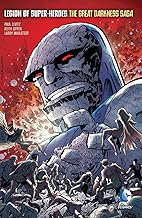 Written by Paul Levitz. Pencils by Keith Giffen, Pat Broderick, with Carmine Infantino, Howard Bender. Inks by Larry Mahlstedt, Bruce D. Patterson, others.
Colours/letters: various
Reprinting: The Legion of Super-Heroes 284-296, Annual #1 (1982-1983)
Additional notes: new intro by Levitz; covers; examples of script breakdowns.
Rating: * * * * * (out of 5)
Number of readings: 1 (some more)
Reviewed: Jan. 2024
This is actually the 2nd version of a LSH collection of The Great Darkness Saga. The first was released in the earlier days of the TPB Revolution (ie: when US comics started collecting monthly comics in TPB editions) and focused, naturally enough, on the eponymous saga, which ran about five issues. This latter day edition is part of the later trend of more "omnibus" style collections, collecting a longer, usually sequential, run of issues.
I had enjoyed the saga in its earlier, focused collection (and just for completists' sake I've left the original review below this one). But I'll admit -- this bigger volume is better.
It's better because, as is common in comics, there can be a slow build up and foreshadowing to "epic" sagas, so here we get that, the teasing of the coming Great Darkness plot in cryptic sub-plots and cutaways, before it actually explodes into the main event. And we get a couple of issues afterward that serve as an epilogue and a palate cleanser. Plus there are other plot threads that get teased along and can resolve in these issues -- such as a thread where Chameleon Boy goes off half-cocked, creates an inter-galactic incident, and faces criminal charges as a repercussion; or romantic/relationship threads that affect various characters (notably Light Lass and Timber Wolf); a leadership election is stretched over a few issues; and in one issue there's a brief, cryptic reference to Green Lanterns not being allowed on earth in the Legion's 30th Century -- and a few issues later we are told why in a flashback adventure (which appealingly harkens back to the early costumes and with a guest artist, Howard Bender, evoking a 1960s, Curt Swan-era LSH style).
The result can feel like a truly epic "graphic novel."
It's just an overall satisfying tome, a book to have on your shelf representing -- arguably -- a creative highpoint for the Legion.
Writer Paul Levitz had been writing the Legion off and on for a number of years, although often in collaboration with others, or as a kind of tag team (where he might write an issue, then another writer write the next, then he might write another, etc.) So it's possible this represents him finally settling in and taking control of the team as "his" property. Or his and artist Keith Giffen, who joins him early in this run and is soon sharing a co-plotting credit.
Early issues are drawn by Pat Broderick with his robust, energetic style, well-suited to the clean, Gernsbackian sci-fi of the Legion. But Giffen definitely brings a more intriguing eye to the proceedings. Oh, it's not that his basic drawing is any better than Broderick's. Indeed, Giffen's figures can be a bit stiff, his faces a bit uniform. But his story-boarding, his composition, is quite striking and can be eclectic. And he's even more suited to the milieu of this hi-tech future, so much the antithesis of much of sci-fi with its reliance on "gritty" futures or post-apocalypse vistas. This is Star Trek taken to the nth degree, of bright ships, swishing doors, clean corridors. A hopeful, optimistic future -- or escapism, if you prefer. And Giffen really brings it alive and imbues it with atmosphere.
The Great Darkness Saga is an enjoyable effort, generating a certain unease, a sense of a threat greater than the Legion has faced before. But it's not without its flaws. The villain is, of course, Darkseid -- no spoiler, 'cause he's on the cover. And it's sort of an odd story as that's both treated as a mystery (since the Legion has never heard of Darkseid in their future era) even as the clues are pretty obvious, pretty early, if you know your DC mythology. And as the story moves into the climax, it kind of draws upon Darkseid/New Gods lore in a way that can seem a bit Deus ex Machina dropped into this Legion milieu without context.
But that's also why this larger, omnibus edition works better. For the simple reason that saga is only part of the material here, so it doesn't have to carry the whole entertainment value on its shoulders alone. So there are other adventures, some one-issue plots, some stretched over a few issues, embellished by sub-plots that can unfold.
One of the fun things about the Legion in the 1970s and into the 1980s was the use of back up stories. As a result the tales here can run the gamut from short vignettes, to full issues, to multi-part sagas; from character pieces, to bombastic action tales. And the vast membership of the team alone means different stories can focus on different characters, or different pairings of characters, so that it can rarely grow stale. Among one of the best non-Darkseid stories here is the first ever Legion Annual which, arguably, remains one of the best single-issue Legion adventures I've ever read, with its mix of character introspection, action, and sheer apocalyptic danger! (I read it in my youth when it first came out -- so I may be biased!) And the issue where Chameleon Boy leads an (ill-conceived) mission to the Khund homeworld is quite atmospheric.
Admittedly both the strength and weakness of the Legion is the aforementioned large membership. You can't get bored with all those characters, any one of which might be featured in the next story. But they're a bit interchangeable, often with little difference between how one character is portrayed compared to another. Some characters are hot headed, others level headed; there's an attempt to suggest Star Boy is the wisecracker of the team...but half his quips could be said by Sun Boy or Ultra Boy. In fact this homogeneity among the group seems deliberate at times, such as early in these issues having Timber Wolf -- who for the last few years previous had been drawn with pupil-less eyes and hair teased into ear-shapes ala Marvel Comics' Wolverine -- getting plastic surgery to return him to looking like a normal human; and like most of the LSH. This is how Timber Wolf originally looked and I suspect Levitz was nostalgic for the Timber Wolf from his childhood. But it means one of the few Legionnaires with a unique look...is made more generic (and for me: the pupil-less TW was who I grew up with!)
But equally this homogeneity of characters is maybe part of the appeal of the LSH. Making the team seem less like a cartoony collection of exaggerated archetypes and more like a believable, and relatable, group of likeable young people.
This was followed by another omnibus-style collection called The Curse that picks up where this ends. And given the Great Darkness plot ends with Darkseid vowing to lay a curse on the team, you can infer that's followed up on in the next TPB. Which maybe says something else about...something. Because as I finish this collection, I'm not necessarily in a hurry to grab the next volume -- not after binging all these issues!
But unlike some lengthy collections, where I can kind of reach the end feeling as though maybe it went longer than I wanted, my enthusiasm never waned, either.
Maybe that's the thing. My lack of interest in jumping into The Curse is less a mark against the series and more a sign this omnibus version of The Great Darkness Saga was sufficiently satisfying I can let it sit with me for a while, rather than impatiently moving onto the next volume. (And, besides, I might get to The Curse at some point -- depending on my wallet).
A strong, enjoyable collection that really does pull off that rare feet of satisfying as a complete volume (even if some threads are left dangling). It serves as a satisfying epic graphic novel of the team. If you were only going to put one LSH collection on your shelf...it would probably be this one.
|
The Legion of Super-Heroes: The Great Darkness Saga (first edition) 1989 (TPB) 192 pages
Reprinting: The Legion of Super-Heroes (1st series) #290-294, Annual #3, plus a short story from Legion of Super-Heroes #287 (1982-1984) Additional notes: intro by Paul Levitz; covers Rating: * * * * (out of 5) Number of readings: 1 Reviewed: Apr. 2015 This was re-released some years later as an expanded volume, now reprinting #284-296, and Annual #1, rather than #3 -- presumably as part of the trend toward chronological "omnibus" collections.
The Great Darkness Saga has long been considered one of the greatest Legion epics -- admittedly, that's partly because there weren't that many "epics" anyway (especially from the Silver/Bronze Age). Certainly for a long time it was pretty much the only LSH TPB around, despite the team itself being popular -- though other TPBs have been released in later years.
The plot involves a great menace that arises in the team's 30th Century intergalactic future -- a villain so powerful, so unstoppable, and so mysterious, the team spends the first few issues counting it a "victory" if they don't lose too badly. Of course it's unclear what the readers' were supposed to guess about the villain's identity. Anyone reading it now knows who it is -- he's featured on the cover! So yes -- it's Darkseid, DC's all-purpose uber-villain. But even though he's not technically revealed until the end of the penultimate chapter, one suspects astute readers picked up on the clues earlier.
And to its credit, it's probably an interesting use of a recurring foe -- by having it not be the Legion's foe. So the story can mix the idea of laying clues that build to a revelation that will have resonance for many comics fans -- even as it can be a genuine surprise to the heroes, and really can represent a menace greater than any they've fought before (as opposed to being someone they've defeated in the past).
At the same time, it does means it's an epic saga that, especially as you get to the climax, kind of weakens its own story simply because it becomes increasingly rooted in the reader bringing in knowledge from other comics. And not even other Legion comics!
But before we get to that, I'll say The Great Darkness Saga does genuinely live up to some of its hype. It really is an exciting, suspenseful, and engrossing read. I had been getting a bit frustrated recently (as I do) not really finding a comic saga that truly gripped me. Oh, I was certainly reading stories I enjoyed, that held my attention -- but not one that actually struck me as a really great read. But this one -- this over three decade old story -- did.
Partly, of course, I just have a general affection for the Legion and their milieu. Oh, I'm not a major fan, but I do have an affection for them. And here long time writer Paul Levitz does do a particularly good job with the personalities. The Legion has always had the largest team membership of any super hero group, but the team members themselves don't necessarily have the most vivid or distinctive personalities. It can result in a lot of fairly anonymous heroes running about. But the flip side to that lack of "extreme" personality traits is the characters can also come across as more real, more believable than a lot of super heroes, their interaction more like actual people rather than cartoony archetypes. And here Levitz does do a good job of tinging this character with a certain brashness, this character with a certain gentleness, etc. In other words, enough of them have some character nuance.
Giffen's art is solid and effective -- particularly atmospheric in terms of creating this striking, hi-tech future of gleaming space ships and spotless corridors. His faces and figures are a bit on the stiff side -- not exactly given to dynamic poses or nuanced expressions (within a few years of this his style would evolve into a more stylish, if cartoony, style). But his composition and story-boarding is quite good, the scenes generally a mix of clear, well-told sequences with some interesting breakdowns and stylish quirks. A few years later he would often focus more on just story-boarding and lay-outs for other artists to pencil over. (A side point: in one splash page, Giffen draws the characters to resemble the Sistine Chapel painting of God and Adam touching fingers. It reminded me of how in the subsequent Eye for an Eye collection he did a panel to resemble DaVinci's The Last Supper. But in both cases I fail to grasp any subtext).
The other major artist here is Curt Swan, who draws the 40 page annual (Pat Broderick draws the opening short prologue). Swan has an unsplashy style that, nonetheless, is striking for that, for his clean, realist, faces and figures. And like Giffen, he's considered a seminal LSH artist (having drawn some of their adventures in the 1960s). I am, I'll admit, a big Curt Swan fan.
While the plot itself does genuinely create a sense of a building, unstoppable menace the likes of which the Legion has never faced before. I say "building" yet equally the action starts pretty quick and doesn't really let up, even as there's enough time spent on the characters standing around and strategizing that it's not just mindless fisticuffs. There are also sub-plots, from character-relationship threads to a vote for a new Legion leader that is teased through a few issues.
The story sets the stage with an ominous prologue (a short back up tale from LSH #287) of Mon-El and Shadow Lass discovering a seeming dead world that proves not so dead. Part of the mystery for the characters as the story progresses is that the Legion has never even heard of Darkseid. By the time of The Legion's 30th Century he's little more than a half-forgotten myth.
Maybe it's because I was enjoying the saga more than I anticipated that when it moves into the climax it gets a bit disappointing. An issue ends promising the next issue would be the "conclusion" -- when I had assumed we were still in the middle of the story! Because, after all is said and done, the plot never quite becomes more than a collection of battles against a mysterious menace who's just interested in, well, destruction or, at best, conquering the galaxy. I was sort of anticipating a few more plot twists and turns, a few extra story threads to weave around each other. In other words, it doesn't quite fulfil the promise of a "saga" -- at least as I would use the term.
It also draws upon -- and relies upon -- a lot of outside information. Admittedly, I had that info, so it didn't affect me. But as I've said before, I often review these TPBs from the point of view of asking: how well does it read, just picked up and read for itself?
There's some on-going Legion stuff that is referenced, hinting at some recent events (Chameleon Boy is charged with treason over a previous botched mission) -- but that's to be expected in an on going series. But when we get into the climax of the Darkseid stuff suddenly the story is drawing upon a lot of Darkseid/New Gods lore (at one point a footnote even says if you aren't familiar with the New Gods it's "too complicated to explain here.") It isn't that the story is incoherent or can't be followed -- it just kind of lacks resonance as suddenly the story is being shaped (and Darkseid's ultimate defeat precipitated) by things that aren't really foreshadowed in these issues.
I suppose that's a quibble. If you are familiar with the New Gods, does it matter? But I just have fondness for stories -- particularly when collected in a TPB -- that feel like a self-contained story. But this is a not uncommon situation in comics, where a climactic issue might invoke some surprise guest star, or a revelation that harkens back to some long ago adventure. It's fine if you're into continuity -- more frustrating if you yearn for a well-plotted story told within the pages presented.
Funnily, part way through this story Levitz starts sharing co-plotting credit with artist Keith Giffen. One wonders if that was simply an official acknowledgement of their existing partnership, or whether Giffen started contributing more in that department (the two would co-plot most of the remainder of their Legion run for the next few dozen issues). The reason I ask is because one might almost wonder if it was a sign that Levitz was having trouble figuring out how to resolve it. Because I'm just not sure long form stories were his forte (his previous "great" Legion epic, the as-yet uncollected Earth-War Saga, I felt started great but fizzled -- and in that case, supposedly even the artist bowed out midway through, feeling it wasn't really living up to its potential).
This collection wraps up with The Legion of Super-Heroes Annual #3, with Giffen & Levitz still driving the story, but classic Legion artist Curt Swan on pencils (inked by Romeo Tanghal). It's sort of an odd inclusion, since it both is, and isn't, related to the main story (perhaps explaining why, when DC re-released The Great Darkness Saga as a later TPB, now with more of the surrounding comics -- it actually dropped this from that collection). The main story collected here ended with Darkseid vowing the Legionnaires would suffer his curse, and the Annual (published two years later) makes good on that, and also involves a lot of darkness -- this time, a literal pall of blackness. But Darkseid himself isn't directly involved. The plot involves minions of the Legion's foe, Mordru, trying to revive him after his powers were drained by Darkseid. So, as I say, it does connect to the main story, but is ultimately a separate plot. And despite it being great to see Swan back drawing the team, it has trouble generating true excitement or gravitas, never successfully feeling like a double-sized annual in terms of plot.
But for all my criticism, this TPB is still a thoroughly enjoyable read. It's just it started seeming as though it truly was going to be "great," but by the end kind of went the way of too many comic book sagas. More emphasis on fighting than plotting; a story that relies too much upon previous lore; and, in the case of the Legion, a desire to work in so many extraneous Legionnaires by the end, it kind of loses the character focus.
|
 Written by Paul Levitz (co-plotter Keith Giffen). Pencils by Keith Giffen, Curt Swan, with Pat Broderick. Inks by Larry Mahlstedt, Romeo Tanghal.
The
Legion of Super-Heroes: The Life and Death of Ferro Lad
2009 (HC) __ pages
(DC Comics Classics Library)
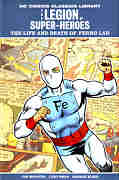 Written
by Jim Shooter. Pencils by Curt Swan, with Sheldon Moltoff. Inks by George
Klein.
Written
by Jim Shooter. Pencils by Curt Swan, with Sheldon Moltoff. Inks by George
Klein.
Colours/letters: various.
Reprinting: Adventure Comics #346, 347, 352-355, 357 (1966-1967)
Rating: * * * * (out of 5)
Number of readings: 2
Some ads for this collection list #324-325 (the classic "adult legion" story) as being included, other ads, though, don't -- and as I'm reviewing this based on the original comics, I can't be sure which is the true contents.
With the proliferation of collections these days, it's often a question as to why certain comics have been collected in certain formats. Particularly with DC now starting a whole new series of hardcover compilations -- the grandiously named "DC Classics Library". In this case, the second volume in the "classics library" series focuses on the Legion of Super-Heroes, and by selecting issues around a long ago, fairly obscure Legion character it might lead one to assume this is some classic saga of rich emotion and poignant, nuanced character development.
It isn't.
When Ferro Lad is introduced to the team, he joins with a bunch of other new members, including far more significant Karate Kid and Princess Projectra. And though Ferro Lad is certainly a pleasant enough lad...he hardly stands out as a personality (Karate Kid gets more page time). And, when a few issues later he is killed off...it seems perfunctory and could've been any one of the team. Though I suspect it was a relatively novel idea to kill off a regular character (even if the fact that he's killed off a few issues after his introduction leads one to suspect he was introduced...simply in order to kill off a "regular"). And of course, these issues are also available in DC's Legion "Archive" collections (vol. 5 and 6), and in the economical, black & white "Showcase presents the Legion of Super-Heroes" (vol. 3).
One suspects the real impetus for this collection was to throw together a book of Jim Shooter-Curt Swan issues, a duo that has come to be viewed as the first truly "classic" Legion creative team, and discovering these issues also included some particularly seminal additions to the Legion mythos, the editors decided to wrap the collection around the theme of Ferro Lad. In fact, I believe #346 was Shooter's first Legion script (written when he was still a teenager!) and, as mentioned, not only does this collection include the introduction of Karate Kid and Princess Projectra, but we also get the first references to the Khund (an adversarial alien race that continue to pop up in DC comics to this day), the Controllers, the introduction of the villainous Fatal Five, and the galaxy destroying menace of the Sun-Eater -- all within these few issues!
So the opening two-parter has a quartet of new members joining the team (including Ferro Lad) just as the alien Khund make threats to invade earth. While attempting to protect earth's defense system, sabotage results, leading the team to suspect they have a traitor among them. The first issue is drawn by Sheldon Moltoff serviceably enough for the era, but it's Swan on the second half (and all the subsequent issues) that's the real treat, with his clean, realist art, he set an artistic bench mark for the series. The writing is, of course, corny, full of goofy exclamations and paper-thin motivation (the comics back then unapologetically written for kids) -- yet Shooter does manage to generate a fair amount a suspense and excitement, of the Legion genuinely having to struggle for victory as sabotage erodes earth's defences and the invasion fleet approaches. There's a nice bit of suspicion among the team (even if it's not hard too guess the traitor if you know your Legion membership), and even a bit of surprisingly modern wit as Karate Kid leaps toward a space craft, facing a kilometres high death plunge if he misses, and thinking wryly to himself: "If I miss, I promise not to try this again!" It's an enjoyable adventure.
The next two parter is crammed full of ideas, from the apocalyptic Sun Eater, a menace that consumes whole suns, to the introduction of the Fatal Five -- a colourful group -- and the off beat idea that the heroes and villains must ally themselves against the greater threat. But despite all this, it didn't strike me as quite as effective as the earlier traitor story. Despite the machinations and scheming of the villains, the plot itself can get a bit repetitive. And Ferro Lad's noble sacrifice just seems thrown in at the last minute and over with in a few panels.
In fact, the Ferro Lad stuff only really lives up to the potential after he's dead! Because the final tale here, "The Ghost of Ferro Lad", is really a stand out story, perhaps showing young Shooter evolving as a storyteller. It more effectively plays out the emotional repercussions of Ferro Lad's sacrifice for the team, their sense of guilt, as well as being a decent spooker as the Legion members find themselves being haunted by his angry ghost -- a fact made more effective by the fact that Legionnaires not involved in his death aren't being haunted and so disbelieve the members who are.
In between is the fondly remembered "adult legion" two-part story, which may have been a last minute inclusion -- assuming it is in this book: some ads for this collection don't list these issues...but DC's official website does. Re-reading it, I realize it does make references to Ferro Lad's death, making it a legitimate part of the eponymous "theme". It's been reprinted a number of times over the years -- most recently in the 2007 TPB collection, The Legion of Super-Heroes: 1, 050 Years of the Future. In it the adult Superman decides to see what his old Legion colleagues are up to as adults, and finds the team being plagued by a mysterious foe who seems to know their H.Q.s secrets...which then segues into the peripherally connected tale of them battling the Legion of (Adult) Super-Villains. For the time it was a neat idea, showing the possible future of the team and characters (and, instead of being ignored, some of the projections were incorporated into later stories). Admittedly, it doesn't maybe offer much emotional drama the way such "future" stories can -- there's very little in the plot that couldn't have been a regular Legion story. But it's enjoyable (particularly the first part) and, again, is a reflection of just how creative the Shooter-Swan period was, how influential it was on the series, and why fans regard it as a seminal era.
I question whether these issues really warrant such a hardcover, prestigious -- expensive -- collection. After all, if one wants that format, DC already has its prestigious, expensive Archive editions. Obviously, these issues reflect their time -- the dialogue can be corny, the emotion/characterization thin, the plotting a bit silly. But there is a fast paced, entertainment value. Swan's art is clean and attractive, beautifully realizing this Gernsbackian future of intergalactic travel and tidy cities. And Shooter's stories are full of imaginative ideas. As dramas, the first story arc, involving the possible traitor in their ranks, and especially the superb Ghost of Ferro Lad story, are the best.
So as a sample of this "classic" era, given a unifying theme by the presence of Ferro Lad, it hits the spot.
This is a review of the story as it was originally serialized in the monthly comics.
ON TO (to Legion reviews
page four) BACK (to Legion reviews
page two)
Back to complete list of all GNs/TPB reviews
OR
Back to 