 The
Masked Bookwyrm's Graphic Novel (& TPB) Reviews
The
Masked Bookwyrm's Graphic Novel (& TPB) Reviews
Iron Man Graphic Novel and TPB Reviews ~ Page 4
for a complete alphabetical list of ALL reviews start here
A
- B - C - D
- E - F - G
- H - I - J
- K - L - M
- N - O - P
- Q - R - S
- T - U - V
- W - X - Y - Z
 The
Power of Iron Man
1989 (SC TPB) 160 pgs.
The
Power of Iron Man
1989 (SC TPB) 160 pgs.
Re-issued as Iron Man: Demon in a Bottle
Reprinting: Iron Man (1st series) #120-128 (1979) without covers
Written by David Michelinie (plotting
Michelinie and Bob Layton). Pencils by John Romita, Jr (and Carmine Infantino).
Inked by Bob Layton.
Colours/Letters: various. Editor:
Roger Stern.
Additional notes: intro by Stan Lee
Rating: * * * * 1/2 (out of 5)
Number of readings: 2
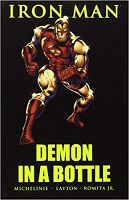 This collection of nine consecutive
Iron Man issues completes what I, semi-facetiously, think of as the substance-abuse
trilogy. It began in 1971 when Marvel Comics and Stan Lee decided to buck
the Comics Code's ban on drugs with a three issue run of Spider-Man in
which a longtime supporting character becomes hooked on pills (reprinted
in Spider-Man vs. The Green Goblin and reviewed in my Spider-Man
section). The storyline was a critical success and led to the Comics Code
re-examining its more excessive restrictions. DC Comics immediately tried
to go one better by having an actual costumed sidekick in the pages of
Green Lantern (co-starring Green Arrow) -- the Arrow's sidekick, the coincidentally-named
Speedy -- revealed as a heroin addict (reprinted in Green
Lantern/Green Arrow: More Hard Traveling Heroes).
This collection of nine consecutive
Iron Man issues completes what I, semi-facetiously, think of as the substance-abuse
trilogy. It began in 1971 when Marvel Comics and Stan Lee decided to buck
the Comics Code's ban on drugs with a three issue run of Spider-Man in
which a longtime supporting character becomes hooked on pills (reprinted
in Spider-Man vs. The Green Goblin and reviewed in my Spider-Man
section). The storyline was a critical success and led to the Comics Code
re-examining its more excessive restrictions. DC Comics immediately tried
to go one better by having an actual costumed sidekick in the pages of
Green Lantern (co-starring Green Arrow) -- the Arrow's sidekick, the coincidentally-named
Speedy -- revealed as a heroin addict (reprinted in Green
Lantern/Green Arrow: More Hard Traveling Heroes).
For the next few years comics trundled along, Spidey's pal had a relapse, superheroes tackled drug dealers with more frankness, and troubled heroes were more the norm.
Then, in 1979, the concept was taken one step further. No longer a buddy, no longer a sidekick, what if the actual title character developed a problem? And what if, instead of doing illegal drugs, his vice was perfectly legal, socially acceptable alcohol? What if Iron Man started hitting the sauce?
Perhaps the most effective thing about this storyline is how understated it is. The reader of Iron Man at the time would be largely unaware of where the story's headed. Sure, Iron Man's alter ego, industrialist Tony Stark, is drinking a lot, but it seems a character quirk, nothing more. Instead, the reader's attention is focused on his various high-flying adventures, battling costumed villains or teaming up with the Sub-Mariner, or on the sinister, escalating sub-plot involving Iron Man's mysteriously malfunctioning armor, or Stark's burgeoning romance with Bethany Cabe, or his fears that Stark International will fall to a hostile takeover by the spy agency S.H.I.E.L.D. Along the way there's a reprise of Iron Man's origin and cameos by the Avengers and Ant Man II, as well as a scuffle with a whole slew of obscure Marvel villains.
Writer David Michelinie avoids the preachy, holier-than-thou route, and instead just tells a story that happens to concern a costumed super-hero getting a little...lost. The downside is that Michelinie is maybe a little too soft. Surely the problem with an addiction is how it affects your life, and what happens if your crutch is taken away. Instead Iron Man can still flatten the opposition, and when deprived of a drink, he takes it all in stride. It's not till the final couple of issues that a genuine problem manifests itself.
Of course, I'm underselling this collection. I praise it for its subtlety, then I spend half this review focusing solely on the alcoholism.
The pleasant surprise was how entertaining these issues are, just as superhero adventures. The action and heroics, the sub-plots, all make this a highly entertaining diversion, regardless of any socially relevant intentions.
Michelinie delivers smart writing and plausible, grown up characters that are a pleasure to read and a rich tapestry of plot threads. In fact, the various sub-plots are sometimes more interesting than the main action-adventure heroics which are fun, but not much more. The problem with Iron Man is that he can be too powerful, with a gadget for every crisis, leading to stories that can be simple and simply resolved. He's probably the only superhero who can be more compelling out of costume than in. After all, you've got to love a guy who has everything and still seems to brood as much as Spider-Man.
And there is something appealing about that suit of armor, of physically putting on a costume that protects you from the world. Of course, the symbolism isn't lost on Michelinie and company, perhaps explaining why, of all Mavel's superheroes, Iron Man was selected as the obvious candidate for a bout with the bottle.
My main quibble with these issues is John Romita Jr.'s art. This, among his earliest professional work, is problematic, with uneven handling of figures and physical dimensions. Bob Layton's inks help a lot, and the art certainly doesn't ruin the saga. Carmine Infantino pencils one issue and I actually preferred his guest stint (also benefitting from Layton's inks).
The other quibble is that throughout this collection, Stark is fretting over S.H.I.E.L.D trying to take over his company. The final issues has Tony triumphing over the bottle, and vowing optimistically to win back his company. The thing is, Tony Stark succeeds...in the very next issue! If this collection had included even the first five pages from #129 there would've been complete closure. The Powers-that-be may've elected not to include 129 because the solution, after so long a build up, is so ridiculously easy (remember my comments about simple resolutions?) they might've felt it was artistically better to end with a kind of Scarlett O'Hara optimism than to reprint the actual solution.
More likely, and this is a problem with comics in general, there may've been an inability to recognize the nature of storytelling. The collection was intended to highlight the alcoholism, so the reprint editor may have reached the end of that plot and felt that was enough. I've read other collections which, because they're intended to highlight a particular idea or artist, let stories dangle in mid-plot simply because it doesn't fall into the rigid criteria. But how can the non-comic reading world be expected to take comicbook storytelling seriously if comic folks don't take story -- that is, beginnings, middles, and ends -- seriously themselves?
Admittedly, Tony Stark beating the bottle and vowing to win back his company forms a reasonable finish and the other sub-plots are resolved in these issues. But knowing that it could've been completely wrapped up by reprinting just five more pages, well...
For continuity buffs, another storyline a few years later had him fall off the wagon completely and end up a derelict for a time. But that's something for another day (maybe even another collection). As well, Iron Man's origins date back to Stark being an arms manufacturer during the Vietnam war (a story retold in this collection) but, as mores changed with the times, Stark got out of the arms business. Yet, here, Michelinie makes no comment on whether his version of Stark is an arms manufacturer or not.
The Power of Iron Man is an entertaining read on many levels, juggling fun escapism with serious issues and well-rounded characterization -- even if the action-adventure stuff is a little too simplistic at times.
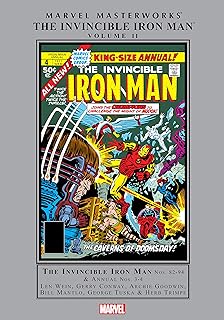 Marvel Masterworks: Iron Man, vol. 11 (2018) 326 pages
Written by Len Wein, Archie Goodwin, Gerry Conway, Bill Mantlo. Pencils by GeorgeTuska, Herb Trimpe, with Sal Buscema. Inks by Marie Severin, Jack Abel, others.
Colours/letters: various
Reprinting: The Invincible Iron Man #82-94, Annual #3, 4 (1976-1977)
Additional notes: intro by Bruce Canwell; covers
Rating: * * * * 1/2 (out of 5)
Number of readings: 1
Review posted: August 2024
The weird thing I've discovered reading old Iron Man collections is -- I'm a bit of a fan. I say that is "weird" because growing up I never really thought of myself as an Iron Man fan, per se. I didn't dislike him. I enjoyed him as a stalwart of the Avengers, but I only had a few scattered Iron Man issues in my collection. Granted, as a kid I didn't collect too many series indefinitely; usually I would follow a particular storyline, or a creative team's tenure. Otherwise the comics I had as a kid were just a few scattered issues of any series.
But darned if I haven't found I enjoy a number of these old collections -- more consistently than I've enjoyed a lot of more recent Iron Man runs.
Part of that is nostalgia, obviously -- the comics (or the style of comics: single tone colours; thought balloons; etc) I grew up with.
Partly it's the more focused storytelling. Stories told in tight two-part sagas; or even one issue adventures. Nowadays a lot of Iron Man (that I've read) are single story arcs stretched over six or more issues -- but without necessarily having the plots (or twists and turns) to justify it.
Another is the humanity -- and vulnerability -- inherent in these old comics. For all that Iron Man is dubbed the "invincible" Iron Man, in a lot of these stories he's anything but. His armour is constantly getting damaged, or loses power in mid-fight, or he's simply confronting foes that are his equal. There's genuine suspense in the action scenes, a sense Iron Man really does have to struggle -- and rely on his wits and guile -- to triumph. Nor is Tony Stark himself the cocky wise-cracker he seems to be today, which can further bleed any sense of genuine danger.
It can just feel like a lot of modern Iron Man writers like the "invincible" idea too much, so the fights are just cake walks for our hero. Or if he is trounced, sustaining life-altering injuries...it's merely an excuse for him to go back to his lab and re-emerge with a cyber-enhanced physique and even more powerful and invincible armour. And I suspect a lot of fans like that.
But I find the interesting stories are ones where the hero is in danger and has to struggle. I know some fans balk at the idea of "weaknesses" (like Superman's kryptonite or Green Lantern and the colour yellow) but I always felt they add to a story. Likewise, Iron Man having a suit that at one moment gives him the power of Superman and a moment later is literally a dead weight, dragging him down, adds to the suspense.
What the hero can do with his amazing powers makes the comics fun -- what he can do when his powers falter makes the comics interesting. It's the see-sawing between the two that make for entertaiment.
Likewise, Tony Stark, Iron Man's alter ego, can feel a little more down to earth and relateable for similar reasons. In fact I've thought Iron Man is one of the few comics where the scenes of the hero out of costume can be as interesting as those where he's in costume. Again -- probably more true of older comics than ones I've read recently where they tend to play up Tony as a smug genius playboy.
This collection is mostly a series of adventures, trotting out familiar (and less familiar) foes for often two-issue adventures. But there are some soap opera-y threads. Some are a bit of house cleaning: long time supporting characters Happy Hogan and Pepper Potts (here, a married couple) depart the series midway through this run (after some angst filled issues as Happy gets hurt trying to help Tony). New supporting characters Krissy Longfellow and Abe Klein get added but to little impact (Krissy's arc will have greater significance in the next volume). Other plots are setting things up for later, including a cop with a vendetta against Tony and a crooked private eye. Their thread goes unresolved here.
But there is a fun (I find) in the way these threads weave through the issues, allowing little cutaways to supporting players, and with even the main adventure plots linking sometimes (a cutaway to a shadowy figure in one adventure will foreshadow their emergence as the villain in the next story).
And the front and centre adventues are -- surprisingly -- quite entertaining. And this despite a rotation of writers (with even artist Herb Trimpe plotting an adventure). I'm someone who has often said -- particularly as I get older and more, maybe, sophisticated -- that the punch-'em-up adventures of comics can be less interesting than the character/soap threads. But here the story telling, the twists and turns, actually do make for good stand alone adventures.
And this is my point about discovering I kind of enjoy Iron Man in this era. Because the plots and the complications (often caused by armour problems) can make for better adventures-of-the-month than other comics of the day. The stories don't always go where you expect, or they take unusual paths to get there. In the Trimpe-plotted story there's a sequence where Tony is wandering around an English village and it's...odd; kind of meandering, but also gentle and atmospheric. A weird plot beat -- and weird can be good.
And this despite the obvious recycling of ideas. As mentioned, most of the villains had appeared before (The Red Ghost, The Controller, and others) -- although some, it should be said, a number of issues before so for readers at the time they were less over-used. (I think it was writer Len Wein who was once quoted expressing the idea that comic fans were transitory, so it was okay to recycle plots every few years). Happy Hogan mutates into a monster -- as he had in one or two long ago stories (due to a bad reaction to a radiation treatment or something). But despite the repetition -- it still manages to hold your attention.
And amid all the solid adventuring, this collection also treats us to the uniqueness of Iron Man Annual #3 -- drawn by Sal Buscema and written by one of comicdoms most celebrated auteur/mavericks, Steve Gerber. It isn't even that the story is that odd -- but the way it unfolds gives it an atypical vibe. Tony Stark is in the Florida Everglades overseeing a construction project, bringing him into contact with the Molecule Man and the swamp creature, the Man-Thing. Gerber being, of course, the chief writer of the Man-Thing's comic from a couple of years previous, and the story links into events from the creature's comic -- as well as the Man-Thing/Molecule Man's appearance in a Marvel Two-in-One issue during Gerber's tenure (included in Marvel Masterworks: Marvel Two-in-One, vol. 1). Though not in a way that isn't explained here. There's just an appeallingly off-kilter vibe to this issue.
The art overall is quite good, handled often by George Tuska, an artist with a long on again, off again association with Iron Man -- possibly the only comic I associate Tuska with as a regular, long-serving artist (Luke Cage being another, for its first couple of years). The other recurring artist is Herb Trimpe. I'm generally a fan of Tuska, his art solid at the least and sparked by interesting angles and poses. I've begun to think of Tuska as a poor man's Gene Colan (another seminal Iron Man artist) in how he lends a fluidity to figures and invests faces with idiosyncratic humanity (and when I say poor man's Colan I mean that as a compliment). Trimpe was an artist I was never that fond of as a kid but tend to appreciate more as an adult, his storytelling/storyboarding often clean and well-done. In a few of these issues he is embellished by Marie Severin (a penciller and Jane-of-All-Trades herself) for some particulatly nice pages, as she rounds out and softens Trimpe's figures.
Two interesting artistic contributions are minor but noteworthy. Bob Layton inks one issue, in one of his earliest Marvel gigs -- Layton later going on to a long and influential association with Iron Man as a signature inker over different artists and a co-plotter with writer David Michelinie. The other is Don Newton inking a back-up tale in Annual #4. Newton had only a brief association with Marvel (though gorgeously drew a memorable Avengers Annual) becoming much more recognizable over at DC drawing long runs of Batman, Shazam, and others.
That back-up story is an oddity that feels like it was dropped into the back of Iron Man because they had nowhere else for it. It's a 5-pager focusing on Midnight -- a minor villain from the Shang Chi, Master of Kung Fu comic. I don't know if Marvel was testing the water to turn him into an ambiguous anti-hero or what (I believe he was killed off in the MOKF story, so this is actually a flashback!). Presumably it found a home in an Iron Man Annual because it involves a villain Iron Man once fought some years before.
There's nothing particularly crucial in these issues for the collector. The changing of the supporting cast or alterations to Iron Man's armour (he drops the nose he had acquired a few issues before) of little significance at the time and even less so decades later. There are threads that set up the much more sustained story arc that unfolds after these issues (in the next Marvel Masterworks collection) but little you can't get recapped in that volume.
But as a collection of Iron Man tales to have on the shelf -- it's a surprisingly solid run, with no really duff issues in the bunch (despite the rotating writer's chair) wth some linking undercurrents (villains in one story turn out to be working for the villain who crops up in the next story). And, of course, the Gerber Annual is particularly memorable. The use of recurring villains can be fun, looking back. And there are some guest stars who drop by for an issue: Daredevil for one; Man-Thing, as mentioned, and Annual #4 is a team-up with the short-lived team, The Champions
If you like your Iron Man a little less "invincible" and think the measure of a superhero is when he has to struggle -- both as a hero and as a man -- this run hits the spot
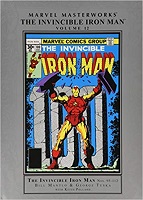
Marvel Masterworks: Iron Man, vol. 12 2019 (HC TPB) 344 pgs.
Written by Bill Mantlo (some story ideas Gerry Conway). Pencils by George Tuska, Keith Pollard, Carmine Infantino. Inks by Mike Esposito, Don Perlin, Fred Kida, others.
Reprinting: The Invincible Iron Man #95-112 (1977-1978)
Rating: * * * * (out of 5)
 Number
of readings: 1
Number
of readings: 1
Reviewed: Oct. 2019
The Marvel Masterworks series --
like other chronological collections/omnibuses (and there have been many
variations on those!) -- is just meant to re-present a sequential run of
comics. But whether by accident or design on the part of the editors, sometimes
the story arcs work out so that the volumes can act almost as "graphic
novels."
Case in point is this 12th volume
in Iron Man Masterwork series. It begins with an obvious enough jumping
on point with Bill Mantlo assuming regular writing duties (Mantlo having
written Iron Man before, but mostly in a pinch hitting way). Although Mantlo
inherits a few plot threads (Stark Industries having been plagued by some
sabotage and slanderous accusations triggering a Senate investigation)
those are easy enough to pick up on. Meanwhile Mantlo quickly starts putting
his pieces on the board and re-organizing the furniture (to mix metaphors)
and developing his own plot threads underneath the adventures-of-the-month
-- as is often the case when a new writer slips into the centre seat.
There's an element of nostalgia:
within an issue or two he has re-introduced plucky SHIELD agent, Jasper
Sitwell, (a character first introduced in the 1960s but not seen in Iron
Man for a few years) as well as sees the return of Madam Masque -- a former
enemy-turned-lover of Iron Man's. Mantlo is also clearly nostalgic for
the days when Tony Stark's heart trouble meant he was always a possible
heartbeat away from death -- an element largely written out by previous
writers thanks to heart surgery. Mantlo just tosses it back in with little
explanation.
The first few issues are mostly
issue or two adventures battling various old foes -- including arch nemesis,
the Mandarin -- while assorted sub-plots and subterfuge provide intriguing
cutaways. Then the series hits its central storyline -- a multi-parter
wherein Stark International falls to a hostile takeover (in more ways than
one) and Tony has to rally and take it back (with a little help from some
friends, Magnificent Seven-style). By this point Mantlo has ratcheted up
the brooding and angst (this Tony Stark a far cry from the hedonistic playboy
other writers have portrayed, but again in a way that feels like Mantlo
wants to recapture some of the flavour of early Iron Man stories -- and
I'll admit I tend to prefer to the Libertine version) as well as giving
-- seeming sincere -- focus to the romantic/mushy stuff. Aside from the
heart problems making every battle a potential life-or-death struggle,
Tony feels so oppressed by his work and responsibilities that losing his
company is almost a relief to him (as he remarks at one point: it's the
first time in years he can live for himself). But eventually his sense
of responsibility guilts him to fight back.
In Mantlo's interpretation, being
millionaire Tony Stark is as much a curse as a blessing.
After this is over, thinks lighten
up (emotionally) and there's a complete change of pace sci-fi storyline
that sees Iron Man heading to the moon and ending up in a space war in
a distant galaxy (involving The Knights of Wundagore, The Colonizers, and
a guest appearance by the Soviet Super Soldiers -- all characters from
other comics). It's a storyline that wraps up by the final issue in this
collection. It allows this collection to work nicely as a fairly stand
alone volume.
Along the way Mantlo almost turns
the comic into a kind of team affair, with various other (mostly minor/second
string) characters dropping by to help out in the longer story arcs (the
cutaways allowing for different players/agendas and a soap opera feel).
Most notably the Jack of Hearts (a Mantlo creation) becomes a de facto
sidekick for a few issues.
And sure, one can quibble about
aspects, and the loose way Mantlo sometimes introduces aspects (like the
heart troubles) or resolves them. Sitwell starts out like his original
1960s incarnation -- plucky and guileless -- but then seems to be altered
to suit Mantlo's brooding tone (and the more "sophisticated" '70s vs. the
"innocent" '60s) and goes through an emotional ringer, teetering on having
an emotional breakdown during the Stark takeover plot. But once that's
done -- he's right back to being plucky as if none of that happened!
But nonetheless it's a surprisingly
enjoyable run. Despite a lot of the early issues running towards big fights
with recycled villains, Mantlo keeps the focus on the character and the
emotion so it doesn't just end up splash pages and generic fights. Iron
Man is one of those characters who works best when writers play up his
limits, rather than his "invincibility." And Mantlo does that in spades,
with the recurring heart trouble, malfunctioning armour, and exhausted
power cells, Iron Man spends a lot of time eking out victories by the skin
of his teeth rather than blithely swaning through conflicts (at one point
fighting a foe while his armour is fissured with cracks!). It makes for
some nice emotion and tension. And I just have a fondness for that old
school style of sub-plots where we can constantly cutaway from the latest
battle to a few panels of this character brooding here, and another character
skulking mysteriously there, and a silhouetted figure plotting over there,
all with cryptic agendas that unfold over a few issues. In short: giving
a soap opera feel to the super heroics.
The lion's share of the art is handled
by George Tuska, a long-serving Iron Man artist who was coming to the end
of his time on the series. Tuska is arguably one of those unsung figures
in comics -- not muscling his way to the top of any "great" comic artist
list, even as I (and a few others) have a lot of affection for his style.
You could almost define him as a poor man's Gene Colan (which sounds like
a put down until you understand what a big Colan fan I am!) -- Colan himself
a seminal Iron Man artist in the 1960s. Tuska isn't on the same level,
but there is a Colan-esque aspect in the way his bodies flow and move energetically,
figures curved and bowed a lot, rather than just having characters stand
stiffly about. And as I say: Tuska was a long-serving Iron Man artist so
seeing his work on the character feels vaguely iconic. The subsequent art
chores switch about a bit, with Carmine Infantino pinch hitting before
Keith Pollard comes on board as the new "regular" penciller -- but he doesn't
seem to stay more than a few issues (mostly inked by Fred Kida, his best
is the final issue here where his pencils are embellished by the brush
of Alfred Alcala).
Obviously, by modern standards the
art is a product of its time: fairly simple and straightforward. But it
tells the tales well enough -- and with the Tuska issues especially enjoying
a slight panache.
With its mix of one or two issue
adventures, an epic saga of industrial espionage, and a multi-parter involving
aliens and deepspace, often interlinked by sub-plots, the issues here run
a gamut of tales, and provide a decent jumping on point while tidily resolving
without much in the way of unresolved plot threads. There's plenty of high
flying action, seat of the pants danger, and enough brooding and angst
to make Spider-Man seem happy and well-adjusted.
Maybe this isn't an especially defining
creative era, but it's an enjoyable run of issues that can keep you turning
pages.
On to Iron Man Reviews Page FIVE
Back to Iron Man Reviews Page THREE
Back to 