 The
Masked Bookwyrm's Graphic Novel (& TPB) Reviews
The
Masked Bookwyrm's Graphic Novel (& TPB) Reviews
Iron Man Graphic Novel and TPB Reviews ~ Page 3
for a complete alphabetical list of ALL reviews start here
A
- B - C - D
- E - F - G
- H - I - J
- K - L - M
- N - O - P
- Q - R - S
- T - U - V
- W - X - Y - Z
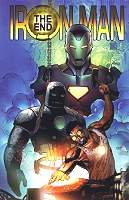 Iron
Man: The End
2010 (SC TPB) 136 pages
Iron
Man: The End
2010 (SC TPB) 136 pages
Written by David Michelinie (co-plotter Bob Layton), with Larry Lieber, Matt Fraction. Pencils by Bernard Chang, Bob Layton, John Romita, Jr., Joe Brozowski, Don Heck, and Kano. Inks by Bob Layton, others.
Colours/letters: various
Reprinting: Iron Man: The End (2009), Iron Man: Requien (2010 - which itself reprints the Iron Man origin from Tales of Suspense #39, 1963, and Iron Man #144, 1981), Iron Man #116, 244 (1978, 1989),
Rating: * * * (out of 5)
Number of readings: 2
Reviewed March 27, 2010
This is a bit of an odd grab bag, with a few recurring themes so that it's hard to say what the overall intent was. Part of it was presumably just that Marvel had already ear marked the one-shots, The End and Requiem, for collection, and just decided to round it out with a couple of other vintage issues. As well, with a new Iron Man movie heading for the theatres, the marketing pressure was on to put out as many Iron Man TPBs as they could to cash in.
One theme might have been a kind of "alpha and omega" idea, presenting various tales embellishing upon Iron Man's origin, with "The End" story, which was an apocryphal "last" Iron Man story. Another theme might have been collecting a bunch of stories by writer Dave Michelinie and co-plotter/inker Bob Layton, a duo that has been involved, off and on, with Iron Man for years and is regarded by many as the dream team of the series.
The 38 page one-shot, The End, is one of a series of specials and mini-series Marvel has produced for various characters, basically positing a possible final story for that character. It might seem like an odd story if this collection were picked up by a casual -- or movie -- fan, as it's basically apocryphal. It even ignores modern continuity, as here it's still a secret that Tony is Iron Man. That may be because this is more than just a possible "last" Iron Man story, but as presented by Michelinie & Layton, a final adventure for their vision of Iron Man...he's even married to Bethany Cabe, the romantic interest they introduced, but I'm not sure has necessarily been maintained by other creative teams over the years. Anyway, it's about an aging Tony, working on one final mega-project for Stark Universal, and coming to terms with his own failing, aging body. There's still action, and Iron Man battling another armoured opponent...but it's also kind of low-key, a character piece. In that sense it works well enough, Michelinie and Layton, no longer spring chickens themselves, are maybe able to imbue the idea of a maturing Tony with authenticity and empathy. Bernard Chang's art is clear and clean. Though a mixture of bitter and sweet, it ends more up-beat than the "end" premise might suggest. At the same time, it is a pretty simple, obvious concept and story.
This is followed by another one-shot -- Requiem -- which was itself mainly a reprint collection (albeit the old stories re-coloured using modern processes). The "new" framing sequence has Tony holed up in a cave in the middle east, reflecting on his origins -- cuing a reprint of the 13 page origin from Tales of Suspense -- and on his first meeting with one-time buddy, Jim Rhodes -- cuing a reprint of IM #144 which was a flashback tale set immediately after the Tales of Suspense tale, with Tony/Iron Man still in the Vietnam jungle. Currently, Tony's origin has been up-dated from Vietnam to Afghanistan, so in order to use the reprints, they come up with the idea that Tony is semi-delusional while remembering, excusing the Vietnam setting and other oddities. It's a kind of clever way of using, and justifying, out of continuity material...even as it seems a tad disrespectful of the old stories. Particularly when Tony (in the framing sequence) dismisses aspects as "gibberish" and making "no sense" -- attitudes modern comics pros and their readers often take toward old comics, apparently oblivious to how silly and unbelievable their modern "sophisticated" stories are. I mean, Tony has wires running out of his head in the modern framing sequence!!!
It's hard for me to get too excited about the origin tale -- simply because I've read it before! But for those who haven't, it's a decent enough tale, with capable Don Heck art -- Heck's later work would tend toward unimpressive, but this was from a better period for him. The basic story of Tony in a war zone, befriended by Prof. Yinsen, was good enough it was kept basically intact for the Iron Man motion picture! The other Vietnam, tale -- now by Michelinie & Layton (with Joe Brozowski providing pencils) -- is an okay romp, adding another chapter to the origin. But it's pretty light and superficial. Though written in 1981, they approach it with all the gung ho jingoism as if it really was written during the war, as Iron Man and Rhodey cavalierly battle and blow up enemy soldiers.
Perhaps the most awkward part is the framing sequence itself, which is clearly tying into some on going events in Iron Man's life that isn't explained and is left unconcluded.
The next issue, Iron Man #116, seems an odd choice. It's an okay actioner, but it is the second of a two-part tale, meaning you kind of come in in the middle and is built upon past events involving Madame Masque, a semi-reformed villainous then dating Tony Stark, and here father, the ubiquitous villain, Count Nefaria. As such, any emotional undercurrents won't have much impact on a reader unfamiliar with the background. It's drawn by John Romita Jr competently enough -- possibly only his second pro work (he came on board the previous issue), not yet having evolved into the fan favourite he would become. Probably the reason for this issues' collection is that it marks the debut of the Michelinie & Layton combo on the title (they took over in mid-story). The fact that the story ends with Madame Masque walking out of Tony's life suggests it was partly a house cleaning issue, that Michelinie & Layton weren't interested in continuing her as the romantic interest.
Head and shoulders, the highlight of the collection is the double-sized Iron Man #244, though it too carries a bit of continuity baggage, as Tony is crippled, having been shot an issue or two before, and it ends with him still in a wheelchair (though he would get better a few issues later). The story -- as they often are (super heroes getting crippled not infrequently) is about him being depressed, rising to face adversity, then reclaiming his life and destiny. Along the way, there's an extended flashback, again to his earliest days. Returning home from Vietnam, he doesn't, at first, intend to pursue a career as a super hero, until circumstances push him that way. It's a densely written tale, more than justifying its page count, with action and adventure (albeit of a simple minded type), but where the focus is very much on the character, and exploring Tony grappling with his various dilemmas -- the modern crippling, and the flashback dealing with his Vietnam-incurred heart trouble. And it's in the Tony Stark stuff that it particularly excells, with Michelinie and Layton (who also draws this one) making you feel his situation, not just observe it. It's probably the most mature, textured of the stories here.
The art throughout this TPB is generally not less than adequate, while never perhaps rising above being pretty decent. Having Layton ink almost all the pencillers does tend to lend the thing a slight uniformity, without hiding the individual pencillers unique strengths (or weaknesses). All draw in a basically realist style. Probably the best art is when Layton pencils on IM #244 and Chang's on The End one-shot.
As I said, you can view this collection as various things -- a chance to see the growth and evolution of the Michelinie/Layton team, from their very first Iron Man story to one of their most recent, and as a chance to see Iron Man's origin retroactively expanded upon with various tales. Or just as a grab bag of tales. In that latter sense, it's an okay read, with none of the tales being bad...while, at the same time, only a few of them being especially noteworthy.
This is a review based on the original comics.
 Iron
Man: Extremis
2007 (SC TPB) 144 pgs.
Iron
Man: Extremis
2007 (SC TPB) 144 pgs.
Written by Warren Ellis. Art by
Adi Granov.
Letters: Randy Gentile. Editor: Tom Brevoort.
Reprinting: Iron Man (3rd or 4th series!) #1-6, 2005-2006 (with covers)
Rating: * 1/2 (out of 5)
Number of readings: 1
Extremis collects the first six issues of yet another restart of Iron Man (man, remember when comics could go for hundreds of issues without anyone feeling they needed to re-start it from an issue #1?). I picked this up on a whim, partly after picking up the mini-series, Dr. Strange: The Oath on a similar whim. On-lines reviews had said the Oath was the best Doc Strange story in years and, reading it, I agreed -- it was a well written, cleverly plotted tale. Coming across reviews of Extremis claiming fan favourite Warren Ellis had delivered the best Iron Man story in years, I decided to try two-times-lucky.
Sadly, I guess I was only one-time-lucky.
Extremis has Iron Man becoming involved when an old friend, a lady scientist, of Tony Stark calls for help. A super soldier serum she was working on has been stolen and injected into a crazed right-wing survivalist with a grudge against the government.
So here's the story in a nutshell: Iron Man tackles a super baddy, gets his butt kicked, so needs to revamp his armour to tackle and defeat the baddy in the climax.
So here's the story in detail: Iron Man tackles a super baddy, gets his butt kicked, so needs to revamp his armour to tackle and defeat the baddy in the climax.
Not exactly War and Peace is it? Yet Ellis manages to get six issues out of this. More and more I find myself talking -- and complaining -- about the way too many modern comics writers just stretch out thin plots over multiple issues that, in the old days, would only warrant an issue or two. And they do it by stretching conversations over a bunch of pages, when all that needs to be said could be said in a few lines, and by breaking down extraneous actions over multiple panels (why cut to a character in an office, when you can show the character get out of his car, walk up the steps, etc.), and long, largely wordless action/fight scenes. In one issue, for example, most of the issue is comprised of two scenes, intercut -- a talking head scene of Tony Stark, his lady friend, and a third character basically lecturing them on their character quirks, and a wordless (and rather bloody) sequence of the villain rampaging through an FBI building.
Comic book marketers point to the fact that TPB collections sell better than monthly comics these days as proof TPBs are the future -- but isn't it possible it's because too many modern writers write monthly comics that aren't really worth picking up once a month? So little happens, so little progresses the overall story arc (as reflected in the generic cover images), that a lot of readers wait for the trades simply because the story isn't interesting enough to hold their attention from month to month.
Ellis tries to toss in some weighty themes and ideas, dealing with Tony's ambivalence about his days as a weapon's designer -- but, the thing is, writers have already covered that ground in earlier Iron Man stories. It's not like Ellis is exploring radical territory. And as too often happens with modern, "sophisticated" writers, he more just explains his ideas rather than develops or explores them. We get exposition rather than dialogue. We get character devoid of characterization. For all that this is about Tony Stark -- there's little of Tony Stark in the story, no sub-plots involving romance or personal troubles, and even when he's Iron Man we get very little in the way of internal musings. In fact, he is crippled so badly he's on the point of death -- but he takes it all in unflappable stride!
Ellis wants to explain (not explore) Tony's character, emphasizing him as a "futurist", one who sees his inventions as benefitting humanity...but doesn't really take it anywhere, or entirely make it convincing. In a way, I'd argue a better interpretation of Tony Stark is that the reason he obsessively-compulsively is constantly tinkering with his Iron Man suit is because, ultimately, it's his sanctuary -- a man who lost his parents when he was young, whose relationships have fizzled, who leads a very public life as a CEO, wunderkind, and playboy, who once found solace in booze...Iron Man is his shell, his protection from the world.
Another thing I just find...tedious. The story is basically geared to re-inventing Iron Man, augmenting his powers (for a character who, I'd argue, is too powerful as it is). And that might be okay, if Ellis had a vision of where he wanted to take this new improved Iron Man -- but I believe this was his only work on the character. He writes it, then bails out, making it all kind of pointless, dramatically speaking. It seems every time you open a comic these days, some "hot" writer is trying to make his mark by re-inventing aspects of the character...when they'd be better sticking with the existing character and work on telling better plots!
Ironically, there are ways Extremis reminds me of Dr. Strange: The Oath, in that both work in flashbacks that reiterate the characters' origins (though here Iron Man's origin has been up-dated from the Vietnam War to the current War on Terror), and both try to throw in weighty themes. It's just the Oath succeeded, and Extremis really doesn't.
The art by Adi Granov is initially quite impressive, of a realist, three-D style using computer colouring -- but it too quickly is overshadowed by its weaknesses. There's a stiffness to the characters, a blandness to the composition. It's like looking at stills lifted from a really hi-end video game (or the animated movie Final Fantasy) in that initially you can be impressed by the realism...but soon you only notice the stiffness the lack of life, of...soul (the "uncanny valley" I think it's called). As well, Granov isn't that hot at backgrounds, often putting his talking heads against ill-defined settings. And he often uses the same hues and shades, so that whether the characters are in a drab garage, or under a bright summer sky, everything has the same dull grey tone.
Ultimately, Extremis is just a thinly plotted, barely developed riff on familiar Iron Man themes, lacking sub-plots, plot twists, or any real emotion (for a supposed character-based story). It would barely justify an annual, let alone 132 pages!
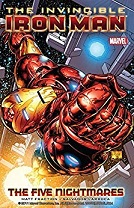 The
Invincible Iron Man: The Five Nightmares
2008 (HC & SC TPB) 144 pgs.
The
Invincible Iron Man: The Five Nightmares
2008 (HC & SC TPB) 144 pgs.
Written by Matt Fraction. Illustrated
by Salavador Larroca.
Colours: Frank D'Armata, with Stephane Peru.
Letters: Chris Eliopoulos. Editors: Warren Simons, Alejandro Arbona.
Reprinting: The Invincible Iron Man #1-6 (2008)
Rating: * * 1/2 (out of 5)
Number of readings: 1
I'm not necessarily a big Iron Man fan. I like the character, he's one of those touchstones I grew up on (he's a character I almost appreciate more as part of The Avengers). But I'm not predisposed to love an Iron Man comic -- that is: the story has to win me over.
Which brings us to The Five Nightmares -- the first story from yet another "new" Iron Man comic...and one sharing shelf space with another on going title: Iron Man: Director of SHIELD. Currently comicdoms most famous billionaire industrialist is also director of Marvel Comic's pre-eminent spy agency, and his secret identity...ain't no secret. This sprang out of Marvel's cross company epic -- Civil War -- in which, in a metaphor for the War on Terror/post-9/11 world, super heroes were told to register with the government or be outlawed. Tony Stark (a.k.a. Iron Man) led the pro-registration movement.
Writer Matt Fraction's opening arc had been getting great reviews, everyone seeming to feel it pulled off the hat trick of being sophisticated drama and old fashioned adventure, while successfully getting away from the moral quagmire raised by the Civil War story.
The idea is that terrorist/suicide bombers are using technology that seems derived from Stark's own Iron Man inventions -- and behind it is one Ezekiel Stane, hitherto unknown son of an old foe, Obidiah Stane. And Ezekiel has augmented himself, to boot.
As a concept it might warrant six issues: international terrorism, personal vendettas, a foe as smart and powerful as Iron Man seeking to destroy him. But in execution...no. Recently reading some old Stan Lee scripted Spider-Man and Daredevil comics from the '60s/early '70s, I felt that, despite some goofy simplicity, Lee often came up with twists and turns that justified multi-issues.
The Five Nightmares doesn't really offer many twists. The few "revelations" it throws at you are kind of undermined because Fraction himself doesn't think to hold back the info for dramatic surprise.
There are logic and storytelling holes. Even Stane's motivation is unclear. He sort of seems to be trying to avenge his father (though Stane rarely mentions his dad)...and sort of motivated by one-up-manship ("Beat that, dad," he mutters at one point). Stane seems less to exist as a character than as a metaphor for the brutality of international terrorists (as he taunts Iron Man by saying he's out of step with the modern world). Yet even then, it's unclear whether Stane is motivated by ideology (like a terrorist) or is simply a mercenary...or is simply a comic book-y foe out for comic book-y revenge
And some of this has been done before in Iron Man stories, as the characters acknowledge (villains mis-using Stark's tech, etc.)
Tony as director of SHIELD doesn't really seem a comfortable fit for the character we used to know. And though running a major corporation and running a major spy organization might seem similar...I'm not sure they are. I realize in his own comic, each super hero gets to be the #1 super hero. But when Tony is described as the smartest guy in the world it seems kind of odd. "Smarts" entails a multitude of disciplines. Tony may be the smartest inventor in the Marvel Universe -- that doesn't make him the smartest, period.
It may seem like an odd thing to quibble about, but a character is as humanized by his short comings as he is glorified by his attributes.
By entrenching Tony in SHIELD, it loses touch with the humanity/reality that was the whole point of the Marvel Age revolution back in the 1960s. Iron Man is a character who can be as interesting out-of-costume as in, but this new direction kind of robs that "civilian" side of things. Even his armour technology has been altered. Whereas once Tony was vulnerable without his suit, his modern armour can wrap around him in an instant so that he's as invulnerable in a tux as he is in his costume.
Even erstwhile secretary, Pepper Potts, has returned to the cast...but now part of the super hero/action, feeding Tony info while in battle, etc. And though it's presumptuous of me to claim any expertise on Pepper -- not having even heard of the character until reading Essential Iron Man 2 -- her personality seems to have been altered to suit the modern sensibility where everyone is a wisecracking member of the "team".
Fraction does try to work in a human drama sub-plot involving Pepper being injured...but it is too rooted in the sci-fi heroism to totally act as a realist anchor to the fantasy.
The art and colour is advanced stuff, particularly the colouring, affecting an almost painted vibe. But though initially impressive, you begin to notice short comings. The characters and expressions are a bit stiff, the backgrounds oddly geometric so that it's sometimes even hard to tell what it is you're supposed to be seeing. And the action scenes can be a bit muddled and confusing, partly because Larroca draws familiar abilities oddly (I think there were a few repulsor blasts here and there) and partly because Iron Man seems to have new tricks that aren't explained in the dialogue. There's a kind of computer-art look to the visuals that may be on purpose, evocative of Crash and Extremis -- but it further means that in the "domestic" scenes, you still don't fully feel like Tony's in the real world.
Still, the art is okay and writer Fraction offers some cute quips and thoughtful observations through Tony's narration. The story is certainly meant to be character driven. The (minor) idea that the Philippines has its own super hero group was interesting and one wouldn't mind seeing more of these characters than their cameo here.
In "Civil War", which pundits viewed as a Republican/Democrat metaphor, a lot of comics reviewers -- seeing themselves as "liberal" -- tended to side with the anti-registration side, therefore seeing Iron Man as the villain of that particular story line. And I sort of got the impression they thought that was Marvel's intention. But the pro-registration side won and Iron Man, the proponent of that side, is starring in two monthly comics...while Captain America, proponent of the anti-registration side...has been killed off! (Heck, Marvel's current regime erased Spider-Man's marriage by introducing a ludicrous reality altering mystical deal with the Devil because they felt it was unacceptable for Spidey and Mary Jane to get a divorce; if that doesn't smack of Republican social-conservatism I don't know what does).
And here we have a story which has echoes of real world terrorism, in which Iron Man leads a raid into Africa based on the erroneous assumption of a connection to the attacks, and which ends with a final message that seems not incompatible with George W. Bush/Republican sentiments.
That doesn't make the story right or wrong. But I do think fans need to be a little more critical in their thinking before blindly assuming today's Marvel is a bastion of liberal sympathies.
The Five Nightmares kind of left me a bit blah. It does tell a story that begins and ends in these pages. But I picked this up hoping for a great Iron Man saga...and didn't get it. The story here is just a tad thin on plot and twists, while often fumbling whatever themes and issues it seems to be trying to address.
This is a review of the story as it was originally serialized in the comics.
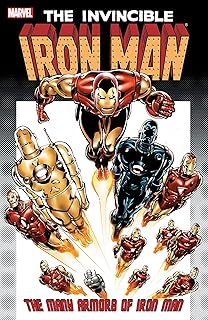 Invincible Iron Man: The Many Armors of Iron Man (1993, 2008) 208 pages
Written by David Michelinie, Bob Layton, Denny O'Neil, Roy Thomas. Pencils by John Romita Jr, MD Bright, Barry Windsor-Smith, Joe Brozowski, Bob Layton. Inks by Bob Layton, Jim Mooney, Akin & Garvey.
Colours: Bob Sharen, others. Letters: various.
Reprinting: Iron Man (1st series) #47, 142-144, 152-153, 200, 218 - with covers
Additional notes: afterward by Bob Layton
Rating: * * * * 1/2 (out of 5)
Number of readings: 1
Review posted: Aug 2024
This collects various Iron Man stories, the linking theme being to present different iterations of Iron Man's armor.
That is, unlike most superheroes who have a specific power/ability/look, Iron Man -- by virtue of Tony Stark being an inventor -- has altered his armour over the years. Although this isn't so much showcasing the different costume designs that have been trotted out over the years (there have been wa-ay more changes than are contained in these pages) but rather stories that feature some sort of modified armour relevant to that month's plot -- even if never seen again or used only in a couple of scenes.
So in one two-party story it begins with Iron Man employing an all-black "stealth" armour -- but after the opening scene (and the stealth part of the operation is over) he reverts back to his then familiar red-gold armour for the rest of the story.
The result -- is pretty fun.
The lion's share of the stories (three) are from the creative team of writer David Michelinie and co-plotter/inker/artist Bob Layton, often seen as one of the great Iron Man creative teams. On one hand, that should please some fans. On the other hand, it maybe defeats the purpose of a collection meant to reflect a variety of Iron Man tales. There is a distinctive style Michelinie/Layton bring to their Iron Man/Tony Stark -- a slightly breezy, unflappable personality (the Tony portrayed by Roy Thomas and Denny O'Neil in their issues is more brooding and angsty).
At the same time, by selecting stories from a more limited span, it allows a sub-plot introduced in one Michelinie/Layton story to actually be followed up on and resolved in the next Michelinie/Layton story! Giving us a kind of Reader's Digest version of a multi-issue story arc.
The collection kicks off with a Roy Thomas penned issue (featuring early Barry Windsor-Smith art -- serviceable but hardly the work fans admire from later in his career). It's mostly just a retelling of Iron Man's origin. It doesn't add anything much to any of the other versions (whether the original, or subsequent re-tellings) but does the trick. Although it does take place during some other events that aren't fully explained (it begins at a funeral for a character without making it clear what happened previously).
Then we get a three-parter with Iron Man in space armour investigating a mysterious space station -- a story that resolves part way into the third issue, allowing Michelinie/Layton to also toss in another -- original -- story revisiting his origins in Vietnam (giving another look at his original grey armour and showing how he first met buddy Jim Rhodes). Then we get a two-parter of Iron Man infiltrating an East German research facility. The third Michelinie-Layton teaming has Iron Man adopting aquatic armour in a story talking him to the bottom of the ocean. Along the way they are joined by John Romita Jr as the primary artist, with Layton himself drawing the ocean story, and Joe Brozowski tackling the Vietnam story.
Inbetween we get the double-sized 200th issue by O'Neil with MD Bright drawing. It's the culmination of a long running sub-plot with Tony having his final showdown with Obidiah Stane (the villain later utilized for the first movie, of course). As such there are threads that have their roots in previous issues. But the core adventure is self-contained enough, with Iron Man adopting a new armour design to take on Stane in his own Iron Monger armour.
And as a grab bag of Iron Man tales -- it's exceptionally good. No story is "bad," and all are pretty solid page turners -- stories long enough that they can develop and unfold (like the space story) while still maintaining a spritely tempo. The Michelinie/Layton issues in particular are pretty nicely self-contained. As mentioned, they even benefit from a sub-plot introduced in one story being resolved in the next.
And though the Thomas and O'Neil issues are a little more rooted in their eras of story threads, they satisfy well-enough read by themselves. The art throughout is solid and clean and easy to follow -- well suited to a series about technology and characters' in shiny armour! The space scenes in the space triology can be particularly striking, visually-speaking.
I wouldn't have minded greater variety in the creative teams. But Michelinie/Layton are considered THE Iron Man team, and I really can't quibble with the stories chosen. I've read too many collections (including "best of..") for various characters where the selected stories are a mixed batch, quality-wise, or are unsatisfying because they're too mired in continuity threads that make no sense read years removed from their eras.
I have sometimes suspected that Michelinie and Layton might lean a bit to the right (small C conservative) and there are a lot of East Bloc villains in their plots (often with motives that barely rise above "bad guy"); and their Vietnam-era story somehow manages to be more problematic/jingoistic than I think even the stories actually written during that era were!
A quibble I sometimes have of their Iron Man stuff is that it can be a bit too breezy, Tony a bit too suave, rarely finding a crisis he can't overcome in a few panels. It maybe suits a character called "invincible" but can rob some of the tension out of scenes. But here, because the stories often involve him using prototype or untested designs, there's often a greater sense of danger and eke-ing out victories by the skin of his teeth.
As a grab bag of random stories focusing on a particular hero, a kind of "Best of..." collection in all but name, The Many Armors of Iron Man stands as a particularly good example of that type of collection. (Which, as I've noted, can often be hit n' miss). I can see re-reading a story here and there when hankering for an Iron Man adventure.
On to Iron Man Reviews Page FOUR
Back to Iron Man Reviews Page TWO
Back to 