 The
Masked Bookwyrm's Graphic Novel (& TPB) Reviews
The
Masked Bookwyrm's Graphic Novel (& TPB) Reviews
Iron Man Graphic Novel and TPB Reviews ~ Page 1
"When industrialist Tony Stark, inventor extraordinaire, garbs himself in solar-charged, steel mesh armor, he becomes the world's greatest human fighting machine..."
for a complete alphabetical list of ALL reviews start here
A - B - C - D - E - F - G - H - I - J - K - L - M - N - O - P - Q - R - S - T - U - V - W - X - Y - Z
for other Iron Man reviews try The Avengers (obviously), Bullet Points, Son of Origins, Hulk: Gray, and others
Iron Man published by Marvel Comics
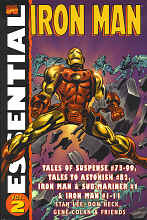 Essential Iron Man, vol. 2 (2004) 584 pages
Written by Stan Lee, Archie Goodwin. Pencils by Gene Colan,
Johnny Craig, George Tuska with Jack Kirby. Inks by Jack Abel, Frank Giacoia,
Johnny Craig.
black and white. Letters: Art Simek, Sam Rosen, others.
Reprinting: (the Iron Man stories from) Tales of Suspense #73-99, Tales to Astonish #82, Iron Man & The Sub-Mariner #1, Iron Man #1-11 (1966-1969) - with covers
Rating: * * * * (out of 5)
Number of readings: 1
Marvel's "Essential" volumes -- wherein a large consecutive run of issues are reprinted in black & white -- can be curious things to try and review. Unlike regular TPB collections, which usually collect a specific story arc, or are collections of selected stories, these are just massive runs of issues, not necessarily forming an arc, or promising significant tales.
Iron Man had started out in 12 page episodes in the comic Tales of Suspense (sharing the comic with a Captain America series) and this begins part way through his Tales of Suspense run, as well as the first eleven issues of his own, full length comic (as well as the 12 page chapter from an Iron Man and Sub-Mariner one-shot which bridged the two...plus an earlier Tales to Astonish issue which was part of a cross over story).
It's a lot of material. And, to be honest, there aren't too many high points. Few classic stories that stand out above the others. One could even dismiss this era of Iron Man as one of a kind of competent mediocrity.
Yet, if so...it's a pretty darn enjoyable mediocrity.
I picked this up on a whim, feeling a tinge of nostalgia for the Iron Man of yesteryear (before the whole Civil War stuff) and because I've developed a great love for Gene Colan's art, which is heartily represented here. Colan and scripter Stan Lee supply the majority of the material, before Archie Goodwin takes over the writing and artists Johnny Craig and then George Tuska come on board for the Iron Man solo issues. (Don Heck, a frequent early Iron Man illustrator, is not in this volume...despite his name on the cover!)
In this collection there are appearances by various familiar adversaries, such as the Mandarin, the Unicorn and the Grey Gargoyle, as well as the introduction of Whitney Frost (later Madame Masque) and Special Agent Jasper Sitwell.
Part of the fun of these Essential volumes is that they allow you to follow the evolving sub-plots and the developing of themes and characters. But they can also draw attention to it if that isn't really being done, or done well. Lee seems to have a tone, and character dynamics, he's playing with...then will sometimes abruptly change direction, as if he lost the sense of where some idea was taking him. Not that it's surprising, given Lee's workload at the time, writing the majority of the Marvel comics -- it's more amazing the series where he did manage to maintain a consistent narrative drive (Spider-Man or the Fantastic Four).
These issues are, of course, steeped (or perhaps mired) in their Cold War era. Industrialist Tony Stark (a.k.a. Iron Man) is first and foremost a weapons designer -- a profession that later generations would see as a tad less romantic (a few years later, with shifting ideological tides, Tony would drop out of the arms business). And communist villains are frequent adversaries -- though the villainy isn't (entirely) one note jingoism (in one story, Iron Man remarks that his communist adversary "had courage"). And Iron Man's most consistently recurring foe, the Chinese villain, the Mandarin, is actually A-political.
Iron Man is slightly unusual in comics because, when Tony Stark, he is just a normal, vulnerable guy, which is why Tony Stark can be as compelling as his alter ego. My complaint about Iron Man has often been that he can be too powerful. But in these earlier stories there's much more emphasis on his armour's limitations, where he barely ekes out a victory before the power drains out or it otherwise shuts down -- it makes for some surprisingly exciting, suspenseful battles. As well, I had once seen Lee refer to Tony Stark as one of his tragic heroes, and (being only familiar with later Iron Man comics) wasn't sure what he meant. But in the earlier issues, it turns out the heart damage Tony suffered as part of his origin (which is re-capped once or twice here) was a continuing dilemma. It creates a melancholic sub-text (and an added nobility to the character) of this guy trying to carry on, and fight the good fight, even as he believes he could checkout at any time (and almost does). He's a playboy millionaire who has everything except, in his mind, a future. During this period, the supporting cast consisted of his secretary Pepper Potts and his best friend, Happy Hogan (gotta love Lee's alliteration). In my review of the early Spider-Man Essential collections, I comment that what distinguished Spider-Man from most super heroes was the large supporting cast -- and here's the flip side, a comic where the supporting players are pretty limited.
Still there's the requisite unrequited love theme, as Pepper loves Tony, but he pushes her away -- not because he's Iron Man, but because with his bad heart, he feels it would be unfair to let her fall in love with a man who might die at anytime. In other words, some of the human drama aspect has nothing, directly, to do with the super heroing. There's also a recurring sub-plot of a Senator trying to investigate Tony.
Dressed up with Colan's moody, shadowy art, there's a sombre mood to some of these early issues (accentuated by the black & white presentation) that is entertaining and effective. But it's also a bit repetitive, with Lee introducing these aspects, then not really seeming to have anywhere he's going with them. The adventures themselves bleed over from story to story, so that often even as a plot resolves...the story still ends on a cliff hanger pushing us into the next one (which is a benefit of these collected editions).
Then the Senator abruptly drops his investigation and Pepper, after many issues pining for Tony, suddenly falls for Happy! And the two drop back to making only irregular appearances. Tony initially takes it hard, and in a brief sequence where he becomes a womanizer and party animal, it's as if Lee wants to explore some emotional angst.
Except...it then seems more just a segue into redefining Tony as more easy going hedonist. And though he still has heart problems, the idea of Tony living under a shadow of death seems forgotten. By this point, a new cast member is added -- SHIELD agent Jasper Sitwell, assigned to provide security for Tony. A comical blend of modesty and arrogance (confident of his SHIELD training) the callow Jasper talks in a never ending stream of jingoistic hyperbole ("In a world beset by dangers...it ill becomes a Special Agent to relax!") that amusingly clashes with Tony's more worldly cynicism. But where Jasper becomes a kind of clever concept is that, instead of being a Maxwell Smart clone, he really is good at his job. Sitwell also gets some serious plot threads, in a sub-plot involving his girlfriend secretly being leader of the nefarious Maggia crime syndicate.
Throughout all this there remains a consistent, if modest, level of enjoyment. Lee writes with a heavy hand, but it's his style, and you can groove to it. The stories rich in emotional angst succeed in their brooding melancholy, occasionally achieving a genuine emotional intensity, and the scenes going for the lighter, more flippant tone are equally fun. All beautifully rendered by Colan's organic, fluid style -- sure, his super heroes can seem a bit weirdly proportioned, but his "domestic" scenes evince a startling realism.
Eventually Archie Goodwin assumes the scripting and takes a bit to settle in, obviously trying to ape Lee's dialogue and exclamations (!). But once he moves into the full length issues of the Iron Man comic, delivers some decent adventure plots, and also seems to have a better grasp of technology -- Lee's idea of technobabble was usually just to add an "o" (Destruct-o beams)! There's less emphasis on the armour's limitations, and though heart problems crop up, it's not a driving concern...with a new sub-plot involving Tony romancing Janice Cord (after all those issues of his rebuffing Pepper 'cause he felt he didn't have the right to romance a woman!).
Art-wise, Colan bows out, replaced by Johnny Craig. Colan's art was a big plus to the series, adding a maturity and stylishness that helped prop up the, admittedly, simple plots and repetitive characterization. Though Craig is nowhere in Colan's league (no one was) -- surprisingly, the art still delivers some goods. Craig's style is more conventional, but it's clean, with well proportioned figures, and a grounded realism. Then Craig is followed by George Tuska, one of those chronically underappreciated artists, but who would go on to have an on again/off again relationship with Iron Man throughout the 1970s. Tuska maybe takes an issue or two to settle in, but bridges Colan and Craig's styles, with a more conventional line work, like Craig, a more "comic booky" look...yet with a hint of Colan in his choice of angles, and the fluid way he can draw figures in action. The visuals may lose out when Colan departs...but remain solid.
I've read some Essential collections where, though not bad, the overall impression left is one of ambivalence, the stories okay page turners, but nothing more. Yet, curiously, despite my freely admitting that there's nothing, perhaps, standout about this era of Iron Man, and the frustrating way themes and sub-plots are teased along...then peter out, I really quite enjoyed this collection. As a read-it-for-what-it-is, the pacing is good (the 12 page chapters of the Tales of Suspense run nicely bite-size), the art (particularly Colan) absorbing, and even if there's an inconsistency in the tone (Tony is an angst riddled guy living under a cloud of death/Tony is a cocky playboy) at least the shifts are -- more or less -- defined, so it's not pingponging back and forth erratically.
So, yeah, it ain't perfect...but it was eminently enjoyable! As a bundle of Iron Man tales, it hits the spot.
Iron Man: Armor Wars (__) 206 pgs.
Reprinting: Iron Man (1st series) #225-232
Additional notes: intro by Micheline; covers Rating: * * * 1/2 (out of 5)
Number of readings: 1
Review posted: May 2024
Arguably two of the best remembered story lines in Iron Man came from the popular team of Micheline & Layton.
The first, commonly identified as the Demon in a Bottle arc (reviewed elsewhere in this section), was a storyline wherein Tony Stark (a.k.a. Iron Man) develops a drinking problem. It was a seminal tale, having reverberations in later stories (both in passing references to Tony being a tea totaler, and inspiring falling-off-the-wagon stories) as well as significant in the annals of superherodom as being the first time someone did a plot like that with a major, title character.
The other fondly recalled arc is this one, Armor Wars -- or as it was titled in the original comics: Stark Wars (Oh! I just got it now as I type this: Stark Wars/Star Wars.) The premise is that industrialist/inventor -- and Iron Man -- Tony Stark discovers his secret Iron Man tech-designs had, unbeknownst to him, long ago been stolen and was the basis for a lot of villains who use technology (as well as some governments, including his own). This makes Tony feel partially responsible for everyone hurt or killed by those villains. So he vows to trackdown his wayward tech and nullify it. But that means ruffling feathers, even alienating friends and allies, since not only does he start aggressively pursing villains, but he even goes up against SHIELD and other "good guys." Tony even has to pretend that Iron Man (who at the point most people believed to be Tony's employee, not the man himself) has gone rogue.
The result is a perfectly enjoyable saga with some interesting emotional beats/angst, and a fun hits parade of familiar tech-based villains, with everyone from minor foes like The Stilt Man, to key adversaries like the Titanium Man, making appearances. But equally it can feel a bit slight for what it is and for an eight issue saga (well, seven issues and an only-loosely-related epilogue -- well, seven issues, but with a double-sized opening chapter). And unlike Demon in a Bottle I think it had considerably less long term relevance to the Iron Man mythos.
Even the logic can feel tenuous. I mean, Tony wants to destroy his wayward tech -- but surely the reality is there will be back-ups or schematics kept by those who misappropriated it. He spends the first few issues not explaining to others (such as the Avengers) why he's behaving the way he is -- but it's unclear why not. Likewise, people act like Iron Man has gone rogue even in the first few issues when he's targeting villains -- but isn't that what super heroes do normally?
Still, part of the fun is that it's a saga comprised of a bunch of mostly one-issue adventures as he takes on different foes (and sometimes friends) and with some variety in the telling, from simply fighting a foe to infiltrating a SHIELD base (to nullify their Mandroid armor suits) to flying to Russia to tackle the Titanium Man and the Crimson Dynamo.
But it's not like this is some complex, twisty epic with intertwining plot threads or surprise twists and turns. Or even much of a character arc. Tony basically decides upon his course of action in chapter one and sticks with it, while pal/sidekick Rhodey (in the years before adopting the iron suit himself, or becoming War Machine) basically kibitzes from the side. There's not much else going on in these issues; no sub-plots and Tony doesn't even seem to have a regular love interest. The main soap opera-y thread is that Tony's secretive behaviour puts a strain on Rhodey's relationship with his girlfriend -- who is in charge of Stark Enterprises' PR department. But even that doesn't develop into much.
One of the things I was thinking while reading this was it felt a bit gimmicky, like it was just set up as an excuse to stage a bunch of fights with fellow armour/tech villains, and possibly an editorial (more than creative) decision to cull Marvel's herd of such characters. And reading writer David Michelinie's introduction (after I read the comics) it seems like I wasn't too far off the mark.
The Michelinie/Layton combo has long been seen by fans as the quintessential dream team of Iron Man, with long associations with the character. And as storytelling goes, the stories are agreeable page turners, mixing lots of a verbose talking head bits of Tony at his office, or brooding about the dilemmas, with colourful Iron Man in action sequences. But weirdly, I'm not sure they offer my favourite take on the character. Despite their earlier alcoholism plot, the Michelinie/Layton take on Tony is a little too confident, a little too suave and unflappable; likewise the Iron Man battles often just involve Iron Man breezing through a conflict (he is nicknamed the "invincible" Iron Man after all) with a tech gimmick for any crisis (although that maybe then means the scenes where he's actually in trouble can have more dramatic impact).
I tend to prefer stories that play up the fallibility of both man and hero. The angst-riddled, broody Tony Stark and action scenes which show the armour's limitations as much as its strengths, as Iron Man must eke out victories from near defeat.
For such a potentially dramatic storyline, in Armor Wars Tony rarely finds a problem he can't out think in a few panels, a villain he can't outmaneuver just as quickly. And for all the moral dilemma at the heart of the saga, of Tony alienating friends and hurting the reputation of his company, there's rarely a moment of self-doubt.
One of the funny things about reading Michelinie/Layton Iron Man stories is I've never fully gotten a bead on their political leanings -- but I've always suspected a soft Libertarian or small C conservative leaning. That may just be the nature of the property -- Tony easily skewing toward a kind of Ayn Randian ubermensch industrialist no matter the politics of the writers. But certainly I've read other takes on the character that don't strike me as tilting in quite the same way.
The art for most of this saga is supplied by M.D. Bright (with Layton serving as the inker, providing a degree of uniformity over the various Michelinie/Layton eras). Bright has an agreeable style, well-proportioned, realist figures, and clear storytelling. But equally his figures can be a bit stiff, and the composition/storyboarding mostly just workmanlike.
The funny thing is Bright makes some specific choices in terms of designing his characters -- the clothes they wear, their hair styles (Tony sports a distracting curly-haired mullet; Rhodey a flat top cut) -- that don't always work. It's weird, because he's clearly put a lot of thought and effort into dressing his characters. And that's one of those arguably unsung parts of comic art. It's one thing to draw superheroes in colourful costumes flinging each other across city streets -- it's another thing to figure out what civilian clothes they should be sporting when sitting around, chatting, and what fashion choices reflect their character, their situation. My point being -- I'm not sure I agree with his designs, but I admire the effort he puts into it.
The final issue -- the epilogue -- is drawn by guest artist Barry Windsor-Smith, a much acclaimed artist (partly because his comics work is few and far between). Windsor-Smith's art often strikes me as gorgeous (at least by this phase in his career -- his early 1970s work was a bit rougher) even as I can find it a bit...aloof. And the issue itself -- literally just a 20 page dream sequence -- can feel a bit pointless. It might have made a better chapter earlier in the saga, since it's meant to reflect Tony's inner turmoil and guilt over how his tech has been used. Stick it in as an early chapter and it helps establish his mindset that drives the saga; but as an epilogue it can feel a bit redundant.
In the end, Armor Wars didn't quite live up to the hype as being one the great comic book (or even great Iron Man) sagas. But it is enjoyable and a nice reflection of the later-stage Bronze Age -- clean, straight forward visuals (and single tone colours) and a lot of storytelling crammed into each issue. And it does work as a story that both fits in a lot of continuity and guest stars (villains and heroes alike) while satisfying as a stand alone read.
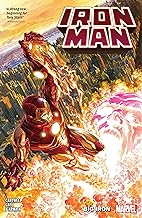
Written by Christopher Cantwell. Illustrated by Cafu.
Reprinting: Iron Man (2020 series) #1-5, with covers Rating: * * 1/2 (out of 5)
Number of readings: 1
Review posted: Aug 2024
(This review is a sort of mash-uo between the review I drafted, but didn't up-load, after 1 reading, and the rewrite/addition after a second reading).
I've said before that the weird thing about modern comics is how they are constantly starting new series from #1 -- even as these are not re-boots or even revivals. Usually the previous iteration of the series ended just a few months before. So even though this is Iron Man #1 -- it starts with all the character baggage from previous runs. With that said, it is clearly meant to be a new direction/starting point.
Tony Stark, famously a billionaire industrialist and head of Stark Industries and, in recent years, publicly known as Iron Man and even head of the spy agency, SHIELD, has basically renounced all that. He's stepped down from his company (and no longer seems to run SHIELD) and wants to try living a simpler life. Oh, he still has millions of dollars at his command, but he's moved to a modest New York apartment and is trying to de-clutter his life. The supporting cast also gets de-cluttered -- at least initially. His main confidant is Patsy Walker (the super heroine Hellcat) who becomes his defacto pal/love interest and the occasional speaker of hard truths.
But while Tony is trying to get his head straight and figure our who he is and what he wants to do with his life, a dangerous menace is building.
And this is a good point to stop and give fair warning: these five issues are just the first Act in an epic storyline that continues into the next two sequential collections. This volume even ends saying "To be continued." So be aware. Even though I had known this sets up the bigger arc, I still assumed it stood on its own for the most part. But no, this is part of the whole Books of Korvac Saga. I'm not sure why it doesn't say that in the title. The next two collections are The Books of Korvac II and The Books of Korvac III, so clearly this is The Books of Korvac I. It's not like Korvac's presence is a surprise twist toward the end of these five issues. Maybe they were just worried about sales if the first volume in a new Iron Man was advertised as just an opening Act.
But this relates to my point about this continuing all the past continuity. Namely: Korvac.
Korvac was a menace that most famously threatened the Avengers in an epic storyline published back in the 1970s (The Korvac Saga -- reviewed in my Avengers section. Although I was not as enthused about it when I finally read it, it nonetheless crops up on "classic" comic book lists even to this day. I'm not sure what had happened inbetween because here the allusions to Korvac mostly refer back to that long ago saga, yet Tony doesn't seem all that surprised by his reappearance after 40 years (yes, I know it's not forty years to the character, but it is to any readers -- how many modern readers would even have read, or heard of, the original 1970s storyline?). Still there's some suggestion Korvac reoccurred once or twice in the interim although little detail is offered.
Anyway, Korvac was seen as a big deal because he was both so powerful the combined Avengers barely managed to defeat him -- and that original storyline was meant to hint at some moral ambiguity, suggesting Korvac's methods were wrong but his goal (to bring about Utopia) was laudable.
So in this return, Korvac is still doing bad things while promising good will result -- even presenting himself as a kind of god, literally revered by his super-villain henchmen. And he's still very powerful.
I had picked up this -- and the subsequent two collections -- on an impulse because they were on sale and I had heard good things about the run. I was looking to read an "epic" and, much to my surprise, I've begun to realize I kind of like Iron Man. I never thought of myself as a fan, but I often enjoy Iron Man collections -- albeit from earlier, Bronze Age/Silver Age eras.
But the result is frustrating.
Not that it's terrible. I can see (some of) why critics liked it. Cantwell writes some witty dialogue and Cafu delivers some breathtaking, photorealistic panels. But despite the clear high-mindedness of some of Cantwell's intentions, he falls into that hubris a lot of comic writers (and writers in general) fall into. Of mistaking the aura of sophistication for the real thing.
The problem is Cantwell wants to use these issues to really delve into Tony Stark, the man. But instead of doing that through stories and scenes, it's mainly through a lot of scenes of Tony (and Patsy) just bluntly discussing his character. And with only really those two as our protagonists, it can make for a lot of repetitious scenes over five issues of the same two people having the same conversations about the same thing.
The writing also gets back to that old adage: show me, don't tell me. In the sense that Cantwell does the opposite.
I realize I'm sounding like an old fogey when I keep harping on this with a lot of modern comics. But contrasting these issues (and other modern era Iron Man comics like Extremis) with, say, Bronze Age comics by Bill Mantlo, Len Wein, and others, I'd argue the modern guys maybe write better, slicker dialogue -- but the old guys did a better job of making Tony and his friends seem like flesh and blood people, with real emotions, real problems, rather than just spokesmen for the writers' psychobabble (which itself can feel a bit like it's just trying to co-opt trendy modern jargon).
Indeed, sometimes when I read stories like this, I wonder if the writer himself has done therapy and is putting that into his story; seeing two people sitting across from each other, discussing one person's emotional and psychological problems, as great, relateable human drama.
Another problem with this (and picking up on my use of "relateable") is the comics building up so much accumulated lore. Once Tony and Patsy start talking about their past, it can get a bit...silly after a while. Like the characters have long since left behind any relatable humanity (which y'know, was kind of the point of the Marvel Age revolution: making heroes human) what with Patsy casually talking about having died and gone to hell and Tony himself having been resurrected from death once or twice!
I had assumed these initial issues would feature adventures of the month while the Korvac plot simmers in the background -- like they'd have done in the Bronze Age. Instead, the adventures of the month are mostly just contextless fights with B-villains and the Korvac stuff, far from being a sub-plot, is front and centre...yet feels undeveloped, like it should be a sub-plot. Korvac has some B-grade villains working for him, literally worshipping him as a God -- without delving into what their motives are or why they are following him. While Korvac continues to act like he's acting for humanity's good without really explaining how or why. It all feels vague and undeveloped. As I say: forgivable if it's just a sub-plot being teased along a few panels per issues. More problematic when it's the main plot.
The art is like the writing -- superficially great, initially, but the flaws start to emerge as the pages trundle by. And again, it reminds me of some other modern-era Iron Man comics. It's lavish and almost Alex Ross-esque in its photo-realism at times. But in other ways, it's a bit stiff, the faces (and their expressions) rather formulaic and lifeless. And the colour palette rather dull so that even scenes in the middle of a sunny day seem weirdly drab. Though Cafu does illustrate a cool looking Iron Man.
And between the writing and the art, the action scenes could seem a bit vague. Like Cantwell wasn't really interested in writing them (or at least sees them as just colourful spectacle rather than scenes meant to create tension, suspense, and through which the character can be explored) and Cafu is better at the drawing than the composition.
Since I've bought the subsequent volumes, we'll see how
the saga unfolds. But -- honestly? If I had just bought this by itself...I'm not sure I'd have bothered pursuing the story into the next collections.
...
And, strangely, after re-reading this volume (after reading the whole Books of Korvac saga a few months ago) I actually liked it less.
Cantwell's writing of characters and dialogue is just very problematic. He's falling into the trap of clearly wanting to write deep, meaningful characterization but at the expense of writing characters. The dialogue is just so many expositional passages that don't really sound like how people actually talk.
In fact there's a whole lot here that feels a bit like Cantwell is just grabbing things from the zeitgeist -- internet memes, catchphrases, social tropes -- and putting them on the page, unprocessed. That is: all artists do that, but their job is to process it first, to understand it before they re-present it. So we have things like a literal re-presentation of that "Sir, this is a Wendy's/Arby's/etc." meme/joke with Tony going on a rambling tirade at a burger joint.
Everyone talks like a straw man pulled out of an internet screed (like the scene where Tony is berated by some teachers when he drops in on a school unannounced).
Again, I guess that's what struck me a second time through: too often characters don't sound like real people. Not minor characters, not major ones.
The funny thing is I can't quite be sure of Cantwell's -- or the comics' -- politics (Iron Man comics always being an interesting political Rorschach blot because the hero is a socially liberal industrialist billionaire). The comic is both having Tony act and do thing that are problematic, and having characters like Patsy (and others) call him out for it -- even as those call-outs are often presented as obnoxious and problematic in their own way. Viewed one way: that makes the comic complicated and nuanced. Viewed another way: it can feel like Cantwell is too focused on using his characters as mouth-pieces for ideas (and memes) and he doesn't have a solid point.
At times, the comic can feel like Cantwell is modelling Tony after Elon Musk -- this being written just before the mask started to come off Musk and people noted not only that he had no clothes, but was maybe a right wing, fash-curious idiot. The whole idea of Tony as this sad sack super genius who just wants to help but is constantly berated (on-line and in person) by the ungrateful masses just hits differently than maybe it did in 2020. But it's problematic now, and was then.
(One thing that sticks out is how Cantwell has scenes of Tony being attacked and hounded by the media -- including in a sit-down interview. I don't know, but usually the criticism of such media coverage of the rich and powerful is how soft-glove it is. Again it's a weird tone of the comic to have Patsy toss terms about "privilege" and the like at Tony, when the comic so much wants to present Tony as this long-suffering martyr assaulted from all sides.)
Again, part of the problem is Cantwell's failure to treat, or be interested, in people beyond straw men and representations of internet cliches.
The next volume in this storyline is: The Books of Korvac II
On to Iron Man reviews page two
Back to 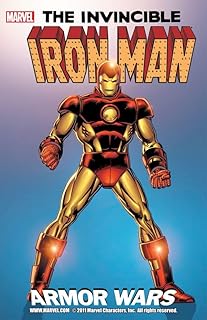 Written by David Micheline (co-plotter Bob Layton). Pencils by Mark D. Bright, with Barry Windsor-Smith. Inks by Bob Layston, with Windsor-Smith.
Colours: Bob Sharen, Nel Yomtov, Barry Windsor-Smith. Letters: Janice Chiang, with Bill Oakley. Editor: Mark Gruenwald.
 Iron
Man: Big Iron
(2021) 128 pgs.
Iron
Man: Big Iron
(2021) 128 pgs.
Colours: Frank D'Armata. Letters: VC's Joe Caramagna.
