 The
Masked Bookwyrm's Graphic Novel (& TPB) Reviews
The
Masked Bookwyrm's Graphic Novel (& TPB) Reviews
Batman ~ C (part 2)
for a complete alphabetical list of ALL reviews start hereA - B - C - D - E - F - G - H - I - J - K - L - M - N - O - P - Q - R - S - T - U - V - W - X - Y - Z
Batman: Collected Legends of the Dark Knight 1994 (TPB) 160 pgs.
 by:
James Robinson / Tim Sale - Alan Grant / Kevin O'Neill - John Francis Moore
/ P. Craig Russell.
by:
James Robinson / Tim Sale - Alan Grant / Kevin O'Neill - John Francis Moore
/ P. Craig Russell.
Colours: various. Letters: various.
Editors: Archie Goodwin, Bill Kaplan.
Reprinting: Batman: Legends of the Dark Knight #32-34, 38, 42-43 (1992, 1993)
Rating: * * * * (out of 5)
Number of readings: 2
This is a collection of stories from Batman: Legends of the Dark Knight (LOTDK), a Bat-comic with no consistent writer-artist, often telling more ambitious or off beat stories than other Bat-titles, usually set during Batman's early years of crime fighting. Critically well regarded, quite a number of the early storylines have been collected in TPBs.
Enough of the preamble, on with the review.
"Blades" (#32-34)
A charming, swashbuckling superhero, the Cavalier, becomes
a media darling when contrasted with Batman's dark, sullen demeanour. But
while Batman is obsessed with a killer of old people, the Cavalier veers
from the straight-and-narrow of superhero-dom. Batman eventually captures
the serial killer...and then must face the Cavalier in a final confrontation.
This is a popular storyline, and it's easy to see why. For one thing, despite the serial killer angle, this isn't a violent, hyper-macho opus the way some Batman stories are presented. It's almost lyrical in spots, and a story rather than just an action piece. The Cavalier isn't a black-hat bad guy, and you've got to love any story where some of the key action scenes aren't Batman beating up bad guys, but Batman saving lives. Too many comic book writer's (even those who decry the juvenileness of the genre) rely solely on violence and fisticuffs to generate excitement, forgetting Batman is as much a defender as an avenger.
Artist Tim Sale has a (slightly) cartoony style (lots of big heads), lending the story its vaguely fairy tale ambience, and he has a nice eye for composition (accentuating one of the story's themes -- showbiz -- with exaggerated shadows and lights, as if Gotham itself were a stage). And colourist Steve Oliff's use of earthtones complements him beautifully, giving Gotham a melancholy, yet hauntingly poetic air.
"Blades" isn't perfect: there's a feeling James Robinson was striving too hard to write a "Great" story, and didn't always write a good one -- it's too aloof in spots. His dialogue lacks naturalism, and the story and characters could've used some fleshing out (it's hard to believe it took 77 pages). And Robinson fails to make all his themes connect.
In the end, though, the strengths of "Blades", the atmosphere, and the tragi-comic figure of the Cavalier, haunt the reader long after the weaknesses are forgotten. Actually, it's one of the more memorable comic book stories to be published in the last few years.
"Legend of the Dark Mite" (#38)
Bat-Mite, the other-dimensional imp conceived in the
more whimsical '50s, is here re-introduced into the modern, more "realistic"
Bat-mythos through the conceit of possibly being a junkie's drug-induced
hallucination.
And it answers the question "what would Batman be like as done by counter-culture animator Ralph Bakshi?"
O.K., O.K., so this satirical curio is better than anything Bakshi's ever done. It's funny in spots, and visually off-kilter, but there's an underlying ugliness and meanness that sours it a bit. The nihilistic-'90s digging its talons into the product of a more guiless era. And though LOTDK is a comic published without Comics Code approval, this is the only story in this collection that seems as though it mightn't have got that approval if it wanted. Though since some of the (admittedly cartoony) violence may be a hallucination, maybe it's justified as unreal.
"Hothouse" (#42, 43)
A new drug leads Batman to the supposedly reformed Pamela
Isley (a.k.a. Poison Ivy), who can have a bio-chemical effect on men. Isley
claims she's an innocent dupe of a couple of drug suppliers, and Batman
wants to believe her...but is he just falling under her spell?
Like "Blades", "Hothouse" also avoids being a testosterone-driven pummel-fest, and is instead more a detective piece. John Francis Moore scripts some nice, wry lines, and Batman is a more compassionate figure than he's often allowed to be, making the story surprisingly ingratiating, particularly after a second reading. Even Ivy is more multi-dimensional, and sympathetic, than she's been in some stories.
Conversely, for a 50 page story, the plot isn't all that complex, or unexpected, making some of the talkie scenes a bit dry occasionally.
The art by P. Craig Russell, like Moore's script, is a mix of plus and minus. His lush, flowing style gives the piece a sense of elegance, but it can be a little too stylized and aloof.
Ultimately, "Hothouse" is a fair, understated effort: likeable, but not riveting.
"Blades" is haunting, "Hothouse" likeable, and "Legend of the Dark Mite" is, well, interesting, making Batman: Collected Legends of the Dark Knight a pleasing compilation -- although you could probably pick up the original issues at a well-stocked comic shop for no more than the price of this collection.
This is a review of the stories originally published in Batman: Legends of the Dark Knight comics.
 Batman:
Contagion 1996 (SC TPB) 267 pgs.
Batman:
Contagion 1996 (SC TPB) 267 pgs.
Written by Chuck Dixon and Dennis O'Neil, Alan Grant with
Doug Moench, Christopher Priest. Art by Vince Giarrano, Dick Giordano,
Barry Kitson, Mike Wieringo, Jim Balent, Tommy Lee Edwards, Kelley Jones,
Graham Nolan, Frank Fosco, Matt Haley. Inks by various.
Colours/letters: various. Editors: Dennis O'Neil, et al.
Reprinting: Azrael #15, 16, Batman #529, Batman: Shadow of the Bat #48, 49, Batman Chronicles #4, Catwoman #31, 32, Detective Comics #695, 696, Robin #27, 28 (1995)
Rating: * (out of 5)
Number of readings: 1
A deadly ebola-like virus achieves epidemic proportions
in Gotham, causing chaos and rioting. Batman and his veritable army of
associates (Robin, Azrael, Catwoman, Nightwing and the Huntress, not to
mention James Gordon & the police, Oracle -- the former Batgirl who
acts as Batman's information/cyber-cowgirl -- and more reluctant allies
like a mercenary named Tracker -- and Catwoman, for that matter -- and
the villainous Poison Ivy) try to control the chaos while also seeking
a cure by tracking down survivors of a previous outbreak in the hope their
blood will provide needed anti-bodies. One of the quests even taking the
characters to Canada.
Who would've thought I'd think a Batman collection was
bad
-- disappointing, sure, medicore, more than once, but bad? And this despite
the fact that it's a huge 12 issue storyline, collected at a relatively
modest price as far as TPBs go, and gives you a crash course in the constantly
expanding world of Bat-related spin-off comics.
But the story is thin with whole issues not amounting
to anything. The TPB reprints thumbnails of the comic covers, but it's
hard to guess to what issues they refer, the covers are so generic (though
subsequently I realized they're numbered). It could be argued that that's
a reflection of the blandness of many of the issues themselves.
With this kind of grim, apocalyptic premise, you might
imagine a thriller spiced with human drama, but it's mainly an action piece.
But pointless action. Knowing from the beginning that there are three previous
survivors of an epidemic means the reader knows the first two searches
will end in failure, muting the suspense, particularly when the quests
themselves are not particularly interesting, or cleverly portrayed.
For a twelve issue epic, there's little in the way of
sub-plots or character arcs that should make the thing a complex, rich
read. Gotham is under the control of a sleazy out-going mayor and an incompetent
police commissioner (Gerry Conway should be flattered: ever since his early
'80s run on Batman, where he used a plotline
involving a mayoral race and wrastling for the Police Commissioner's job,
it seems almost every time I've read Batman in the last two decades, there's
some sort of sub-plot involving those elements -- and it's getting old,
folks!) Anyway, the mayor and the commish, supposedly, bungle the crisis...but
we hardly see them at all, or learn in what way, or why, they mishandle
things. With the exception of the heroes, characters aren't developed beyond
the necessities of a given scene.
Even the heroes are sketchily portrayed. There are some
decent scenes between Batman and Gordon, and some between Alfred and Robin,
but other times...not. Gotham is falling to a plague...but does James Gordon
spare a moment to think about his loved ones? Robin contracts the disease,
but Batman barely blinks an eye. In fact Batman is portrayed as blank and
one-dimensional...and even non-existent. For a TPB called Batman: Contagion,
Bats spends a lot of time in the background. But you get little insight
into most of the heroes, anyway. Alfred, who spends much of the saga in
the background, adds some desperately needed humanity in the latter portion
of the storyline -- then plays a prank that's in such unbelievably bad
taste it's impossible to reconcile with the character and smacks of just
bad writing.
Orchestrating a crossover story involving more than one
writer (though Dixon does the lion's share) must be difficult. In the climax
the heroes discover (and this is not a spoiler, friend) discover
the plague was created by a crazed religious order called St. Dumas (a
recurring force in Azrael comics)...but the heroes knew that in the very
first issue!!! And when you learn just why the order unleashed this
plague on Gotham...well, you can be forgiven for throwing the TPB across
the room in disgust. And there's just a lack of plausibility throughout
-- like why only Batman's cronies are searching for survivors instead of
anyone with real authority? As well, there are technical faux pas
that make you want to buy the staff at DC an atlas for Christmas: Greenland
is not part of Canada, a Torontonian is not an American, and Alaska and
the Yukon are not interchangeable names. Sometimes they seem to know that...sometimes
they don't.
Other qualms arise when you peer beneath the surface text.
A plague sweeps the city, innocents are dying, our heroes speak of saving
Gotham City ("If Gotham dies, they might as well bury me with her," remarks
Gordon)...but they don't seem to care as much about the people who
comprise the city. In Doug Moench's single contribution to the saga, he
has Batman comment: "We can't let death turn lives into (statistical) numbers."
It's a movingly profound comment from the Dark Knight -- too bad Dixon,
Grant and O'Neil hadn't taken it to heart.
A story about a plague could explore issues of paranoia
and prejudice (think of AIDS) but instead, Contagion exploits those
very unsavory attitudes. The plague victims too often are portrayed as
sub-human monsters, to be treated with disgust and horror, not compassion.
What emerges is disturbing. The civilian population is
a mindless mass of instability, falling victim to the plague, or rioting,
with only the superheroes and the police proving their moral fibre. Contrast
that with the closing chapter of the classic Batman:
The Dark Knight Returns, in which Frank Miller portrayed the worst,
yes, but also the best of the common people in a crisis (and it's not like
Miller hasn't had his ethics criticized from time to time). Even the plague
survivors the heroes search for are treated as little more than objects,
or worse, commodities. When one plague survivor is murdered, it takes two
more issues (and Doug Moench again!) to acknowledge that a man was
killed.
Superheroes began as a childish fantasy, then evolved
in the '60s and '70s as an adolescent release, exploiting themes of alienation
and power fantasies -- both subtexts leading pundits to dismiss comics
as juvenile. Yet these '90s comics display a far more disquieting undercurrent,
that of a kind of fascistic wet dream, with the ubermensch of superheroes
and police arrayed against the seething mass, not of super-villains, but
the civilian population. It's a theme that I've commented on in Batman:
The Cult and Legends among others. In
fact, the very cast of comics like Batman have shifted over the years,
dropping civilian supporting players in favour of more and more cops and
costumed heroes.
Other problems arise from the modern editorial attitude
in comics, which is that outsiders are to be discouraged. There's character
stuff that is confusing for the novice. Nowhere would you learn in 12 issues
that Oracle is the Commissioner's daughter. And in one scene, Batman has
inexplicable knowledge of the Penguin's (in a bit part) plan -- inexplicable
if you didn't recognize Batman's alter-ego, "Matches" Malone, in an earlier
Penguin scene. But nowhere is "Matches" identified as such, or as being
a disguised Batman. This contempt for "inexperienced" readers explains
why the comic book audience has imploded so drastically over the years.
There are times when stuff seems to be missing, too, like maybe another
Azrael comic to which the characters refer late in the proceedings.
The art...ah, well, the art. Some of it's good (Matt Haley
on a 10 page Huntress story), some of it's O.K. (Nolan, the Balent/Giordano
combo), and a lot of it struck me, personally, as just Godawful. There's
a lot of use of "Image"-style splash pages and big panels, often for no
dramatic purpose, and artists who studied anatomy by watching Saturday
morning cartoons, and other artists that are so stylized you can't even
tell exactly what's going on. Admittedly, art is a subjective taste, but
aesthetically a lot of it left me cold.
Ultimately Batman: Contagion picks up a little
in the second half (though that may've just been because I had lowered
my expectations by that point), but it's comic booky in all the wrong ways:
glib and superficial and kind of dumb and silly. The plot is blah, the
characters unrealized, and the ideology disquieting. Still, I emerged with
a new respect for Doug Moench (I guy I never much liked as a Batman writer),
so maybe it wasn't a complete loss.
A few years later Batman comics re-explored the same theme
with an epic storyline where Gotham is wrecked by an earthquake and anarchy
ensues. Maybe they learned from Contagion's shortcomings and the Cataclysm/No
Man's Land epic is better. Personally, though, I'm disinclined to give
that second storyline a try after this.
Batman: The Court of Owls Saga: DC Essentials Collection (2019) 350 pgs.
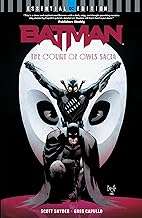 Written by Scott Synder, with James Tynion IV. Art by Greg Capullo, with Rafal Albuquerque. Inks by Jonathan Glapion.
Colours/letters: various.
Reprinting: Batman (2011 series) #1-11, plus a couple of ancillary shorts (not sure from where or if original to this collection)
Additional notes: intro by Synder; covers; sketches, designs, original script draft.
Rating: * * * 1/2 (out of 5)
Number of readings: 1
Reviewed: April 2024
The Court of Owls probably lays some claim to being a modern Bat-classic -- in that it gets referenced a lot, inspired plot elements in both an animated movie and (arguably) the live-action The Batman, and has been collected in various editions (I originally read the first half in its own TPB collection).
Marvel and DC have both responded to lamentations that their back catalogue can be confusing and stories hard to collect with a few "special" collection series. So this edition of The Court of the Owls collects the entirety of the core Batman storyline between one cover, as well as a couple of short ancillary pieces, under the DC Essentials banner. Admittedly this was one of those crossover stories, threads bleeding into Batman-related titles (like Nightwing, etc., explaining why various supporting characters like Nightwing and the multiple Robins pop in and out of the story willnilly). Still, this is a good "read it n' keep it" edition.
With all that said, does the saga live up to the hype? The Court of Owls is certainly a solid adventure-thriller that keeps the pages turning. With that said, it can feel a bit like a great idea that doesn't quite fulfil its potential (reminding me, in a many ways, of Batman: City of Crime).
The premise is that Batman uncovers a sinister and rather creepy conspiracy in Gotham -- a secret society that has lurked behind the scenes not just for years, but centuries. But as Batman begins to investigate what he assumed was just an urban legend, he stirs up the proverbial hornets nest, even being laid siege in his own mansion by the enforcers of the Court's edicts -- the assassins dubbed the Talons.
The art is quite gorgeous and stunning, full of detail and shadows for a suitably atmospheric effect. There's a mix of realism (and 3-dimension to the figures and spaces) with a bit of playful caricature to the faces that reminded me more than a little of Michael Golden and to some extent Will Eisner. Although the style and design of Batman himself often put me in mind of Frank Miller's iconic Dark Knight Returns version of the costume: burly and with stubby ears. While Gotham and the interiors are steeped in history, less a modern metropolis and more Gothic and Edwardian.
But there are some weaknesses to the visuals. Primarily the storytelling itself could occasionally be a bit confusing: a close up where I wasn't sure what we were looking at; an action panel where I was unsure what was happening. Despite the lavish detail to the environments, the wardrobes, even hands and bodies, but faces could be a bit blander, not always conveying much nuance through expressions. The caricaturish element also leads to Bruce looking like a giant and Dick Grayson a teenager -- when surely Dick is an adult these days and should look, if not equal to Bruce, not quite as asymmetrical.
Still, there's no doubt the whole saga benefits from a brooding, enveloping atmosphere, and the art contributes to that a lot.
The story is ambitious and intriguing, as Batman takes on a threat potentially more overwhelming than any costumed villain or mobster -- an entire secret society that has flown under his radar for years.
Although the idea that there's a nursery rhyme about this secret society seems a bit implausible -- or at least that no one in Gotham realizes how weird that is. Especially as the rhyme is explicit. It might have been more plausible to have a local nonsense rhyme -- like Humpty Dumpty -- and Batman only gradually realizes its true significance.
Although maybe this is a good illustration of my bigger issues with the saga: the neat idea but the uneven execution.
Batman discovering there's a secret society that has existed for generations could've led to a neat paranoid thriller as Batman is unsure who is in on the conspiracy. But there's actually little of that in the story (other than a brief sequence where Dick Grayson's DNA is found at a crime scene; but it's not like we believed Dick would turn out to be a villain). Like with many comics, there's little use of a supporting or guest star cast, other than a local politician who is too obviously going to be a plot point by the very fact that he's the only new character. I suppose it's because the story is more focused on physical action with Batman than detective work with Bruce. It's also a bit unclear when the Court makes the connection between Bruce and Batman.
Worse -- the Court itself never really makes sense. It's supposed to be a shadowy inner circle that has ruled Gotham -- yet then in the climax of the story they launch an all out attack on the city elite. But -- I thought the point was they were the city elite? And why if they ruled from the shadows for generations do they now make such a blatant grab for power? (For that matter, if dozens of Gotham's business and civic leaders get massacred wouldn't that draw the attention of outside authorities?)
In the one sequence where Batman encounters the Court it's a creepy scene where they seem like a bunch of demented weirdos -- but Batman is sort of hallucinating so I guess we're not sure how much we can take as real. But all this relates to my point that the creators come up with the neat idea of a secret society -- and then don't seem to have a clear idea in their own minds what it is, what it does, or what to do with it, plot-wise.
Still there are neat aspects, like Batman discovering that Court goes back so far it has influenced Gotham architecture, and that there are hidden Owl chambers built into the very buildings of Gotham.
One of the aspects of the story is to tie it into the Bat-mythology -- essentially retconning. At one point Batman discovers the Court had actually intended to recruit young Dick Grayson as one of their Talons -- until the murder of his parents and adoption by Bruce derailed their plans. As well, Batman even wonders if the court was involved in his own parents murder. Retcons like this aren't inherently bad -- in past iterations of Batman lore we had Joe Chill and Lew Moxon inserted into the backstory over time and arguably it enriched the lore. But it can threaten to tie everything to tightly together.
Another spin on the history was interesting (not good or bad; just interesting) in that it reminded me of a couple of old Bob Haney stories circa the 1970s which added a bizarre twist to the Bat-lore which was, then, mostly ignored by later writers. I don't know if the Court of Owls using something similar is a coincidence or a tip of the hat to Haney. (I'm being vague, because I don't want to give it away, but if you're curious, read the World's Finest issues collected in the Deadman, vol. 4 TPB -- which I'll post a review of at some point if I haven't already whenever you're reading this).
But the problem is the desire to add to the mythology -- while leaving the door open to none of this being true (since Batman is told things by an unreliable source) -- is that it kind of gums up the climax. After spending most of the saga focusing on the Court, the climax turns into a mano-et-mano conflict with a single character that we barely knew and which requires so much verbiage and info dumping it feels like there's more word count in the last couple of issues than the rest of the issues combined! The writing could've been trimmed and tightened and it would've been more effective.
The other problem is that comics are loathe to let a good idea rest and tell a finite saga. So even as we build to a climax it leaves threads dangling in case other writers want to pick up on them, including the Court of Owls itself, with the implication Batman dealt them a blow but the court continues to operate within Gotham. So instead of the Court of Owls being a nice, tidy "graphic novel" it ends, as too many comics do, a bit vaguely and unsatisfying.
And though, as I suggest at the beginning, this is meant to be a nice, easy to collect version of the story, I do wonder if some of the seeming lapses or vague plot points are because they were detailed in concurrent issues of Nightwing or Robin.
Ultimately, is the Court of Owls a decent read? Sure. It's atmospheric and visually sumptuous; the dialogue is sometimes clever and unexpectedly light and witty, and there are some cool scenes and concepts. But it feels like it should've been better, and like Taylor came up with the neat, epic idea...but had trouble figuring out how to fulfil its potential. It does remind me a lot of City of Crime both in themes and in its muddled execution. City of Crime was arguably more ambitious and audacious, but Court of Owls is more successful as just a page turning adventure.
Batman: The Cult (1991) 208 pages.
Written by Jim Starlin. Illustrated by Berni Wrightson.
Painted by Bill Wray.
Letters: John Constanza. Editor:
Denny O'Neil.
Reprinting: Batman: The Cult #1-4 (1988 prestige format mini-series)
Rating: * * * 1/2(out of 5)
Number of readings: more than once
Recommended for Mature Readers
I'm going to do something odd. I recently re-read The Cult after quite a number of years and found I enjoyed it more than my original review (I had rated it 2/5). So just for the sake of posterity I've kept the original review but I've added my recent re-assessment first (I may re-write and consolidate the review later):
Thoughts circa 2014:
Synopsis (from my original review): "Batman is tortured and temporarily brainwashed by the Deacon Blackfire, who's assembling homeless people into an army of brutal vigilantes. Batman joins with this cult, but manages to shake off the brainwashing and escape. But he remains broken inside and scared of the Deacon, allowing the Deacon's army to literally take over Gotham City. Eventually, though, Batman must rally his courage and, with Robin (then Jason Todd), bring down the Deacon Blackfire. The Cult is probably intended as a horror story, more than adventure, and is quite probably the bloodiest Batman story I've ever read, not to mention the grimiest with much of the action taking place in fetid sewers..."
I hadn't re-read The Cult in -- well, a couple of decades probably. (Wow!) So a lot has happened: both to me and to comics. So perhaps it shouldn't be strange that I had a very different reaction to when I read it long ago.
Namely -- it's okay.
Kind of a change from my original review that didn't like it, eh?
Unfortunately, that's not necessarily entirely because it's raised in my estimation, or I've seen greater value and meaning in it that I missed the first time. So much as I've lowered my standards a bit., Or at least, the ensuing decades of comics have lowered my standards. The violence and grittiness I once found a bit off-putting I now kind of shrug off.
Part of that is how gritty and violent a lot of mainstream comics have become. But the other thing -- and a give or take in terms of whether it makes my reviewing better -- is I'm less involved. I've noticed before that my reviews can be more critical the first time I read something, because I'm invested emotionally, I want to be drawn into the story -- and my reviews can be more favourable the more I'm just reading it as a casual distraction. The less I demand/expect, the less I'm disappointed.
At the time this was just at the start of the darker, grittier approach to mainstream comics -- I think it was the first prestige format Batman mini-series to come along after Frank Miller's The Dark Knight Returns, and it was clearly meant to capitalize on that. It's darker, grittier, more adult -- and it makes a lot of use of TV monitors/news reports to tell the tale, just like TDKR.
Indeed, it can feel more than a little like writer Jim Starlin looked at the second issue in Miller's four-part mini-series -- the one where Batman takes on the street gang cum urban army -- and thought: hey, you could get an entire saga out of that idea.
After all, if you think of it, it follows similar themes and arcs. But whereas Miller has Batman be broken in his first encounter with the villain only to rally immediately, Starlin tries to make it deeper and more psychological -- delving into Batman's emotional scars and fears at being broken psychologically. (As if maybe he saw in Miller's episode a missed opportunity).
Even the idea of turning the Batmoblie into a monstrous tank echoes TDKR. (Maybe Starlin saw that as retconning -- introducing the tank-mobile in this contemporary-set saga to foreshadow its use in Miller's future-set saga).
In other ways: The Cult, re-read after so many years, can seem at the least prescient and at most heavily influential on later Batman stories: Knightfall (where Batman is broken, physically and psychologically) and Cataclysm/No Man's Land (where Gotham becomes a lawless no man's land) and others. Although, again, I suppose the similarities between The Cult and TDKR make it had to say which was the greater influence on later Bat-stories. But it does feel like Starlin (and artist Wrightson) deserve some credit as the inspirational architects of subsequent Bat-sagas -- for better or worse, depending on how you feel about the creative success of those later epics-by-committee.
As for The Cult itself? As I say: it's okay. Oh, it's not muscling its way to any Best of... lists, but given my long-held negative memory of it -- I enjoyed it more. Perhaps its strongest aspect is the atmosphere: the way the creators combine to create a palpable, visceral experience -- a dream you slip into every time you sink into another chapter. Wrightson's art is moody and atmospheric (aided and abetted by the colourist, Bill Wray) and really creates a world for the characters to inhabit. My initial review quibbled over his drawing of the superhero aspect -- especially noting that teenage/youth Robin is somewhat over-muscled. But again -- that didn't really bother me this time. The strengths of Wrightson's visuals in the places where he's strong (the Gothic imagery, the horror vibes) overwhelms the weaknesses.
Plus, in this day of computer lettering, I enjoyed old pro, John Costanza's, expressive lettering.
As for Starlin's script/story? Again -- I enjoyed it more. It moves along at a good pace and does generate tension and suspense. For a 200 page saga where a chunk of it involves Batman a prisoner being psychologically (and physically) tortured, the story doesn't get bogged down. I re-read it over just a few days and it held my attention.
Some of my new reaction is because of political changes in the last few decades. With the increasing extremism entering politics from the Right, and personality cults arising around figures like Donald Trump, Starlin's saga of a cult leader and his insane followers taking control of Gotham (and the idea that some "moderate" Gothamites are initially fine with it, thinking the Deacon will improve the city) hits harder and more pointedly than it did when I first read it.
With that said, the socio-political stuff itself is problematic (and also feels like Starlin was inspired by Miller's TDKR). I'm never sure when a creator tries to get political in a commercial narrative how much the "politics" reflect what the writer et al truly believe, and how much hasn't the writer really thought about the issues beyond kneejerk platitudes, and how much it is Bowlderizeed for commercial reasons (ie: you're trying to entertain a broad audience, not alienate potential readers on either side).
Because as much as I suggest it reminded me of the rise of Trump and the Far Right -- in a lot of ways Starlin's saga itself feels right wing and reactionary. The Deacon's followers are criminals and the homeless (the latter a category of people not often well served in superhero comics in general). So even as -- initially -- the Deacon's victims are criminals, the theme of the comic is a very much middle class paranoia: oooh, what if all the dirty, low class people rose up?!? Cops are heroes. Politicians sleazy and unprincipled. There's no racism or other dynamic fuelling the upheaval (as there usually is with right wing populism). So in that sense, The Cult is at best a watered down, a-political drama, failing entirely to confront the real nature of such quasi-populist movements which often are driven by the middle class and invested in racism. At worst, it's a kind of reactionary thriller itself.
But it's entirely in keeping with many superhero (and other movie/TV) stories. Which is why I suggest I'm not sure if Starlin is just simply recycling ideas he's seen elsewhere, rather than this being a representation of his true political thoughts. Or, as I said: that's the point. To present an inoffensive, middle-of-the-road saga that feels like it's being political even as it's not really saying anything too controversial.
Anyway, the long and short of it is that, for whatever reason, revisiting The Cult after a couple of decades of letting it moulder upon my shelf -- I actually thought it was okay. It's very atmospheric and it held my attention through-out -- which is kind of the point of stortytelling.
Original review:
Batman is tortured and temporarily brainwashed by the Deacon Blackfire, who's assembling homeless people into an army of brutal vigilantes. Batman joins with this cult, but manages to shake off the brainwashing and escape. But he remains broken inside and scared of the Deacon, allowing the Deacon's army to literally take over Gotham City. Eventually, though, Batman must rally his courage and, with Robin (then Jason Todd), bring down the Deacon Blackfire.
The Cult is probably intended as a horror story, more than adventure, and is quite probably the bloodiest Batman story I've ever read, not to mention the grimiest with much of the action taking place in fetid sewers. Unfortunately, too much gore can be...too much. After you've seen the umpteenth image of stacked corpses, the story quickly loses its ability to shock.
The first chapter is intriguing as we wonder just who -- or what -- the apparently immortal Deacon is and what are his goals. It's atmospheric in a dark, grim sort of way. Jim Starlin and Berni Wrightson use interesting techniques to portray Batman's drug-induced disorientation. The character-stuff with Batman is decently handled (though has a major misstep in implying Batman kills a man while under the Deacon's sway, yet not having this factor into his later self-recrimination).
But Starlin falls into the lazy trap of concocting a story geared around the stretched-out action scenes, rather than posing questions about the plot or the characters. By chapter two he's exhausted his twists and surprises so that, by the climax, I was actually kind of bored by the lack of plot and characterization.
The socio-political stuff is poorly handled. There are vague comments on religious fanaticism, but nothing insightful. The idea of the Deacon becoming a rallying point for the homeless and disenfranchised is unconvincingly handled: he offers nothing other than his war on crime. Jim Starlin, like a lot of comic writers, seems to forget that, in the real world, there are other things that fuel people's fears: hunger, unemployment, etc. Nor is there any sincere attempt to portray the Deacon's flock of homeless people as anything other than grotesque bad guys.
The idea that some Gothamites rally around the bloody Deacon could've been an intriguing, and disturbing, comment on society...but, likewise, never seems penetrating.
That's assuming all this is even sincere. The story ostensibly decries the fascist Deacon, but the heroes are all gun-totting, non-accountable figures themselves (the police, the army, even Batman himself is outfitted with heavy -- albeit largely non-lethal -- artillery for the climax), while the public, and democratically elected politicians, are treated with utter scorn and contempt.
There are other, less profound, weaknesses. The Deacon himself fails to be intimidating -- in fact, he seems like a bit of a dork -- nor does his character seem to evolve logically. There are weird plot lapses, too, like a scene where a cop volunteers to go undercover in the Deacon's group...but then disappears entirely from the story, or the fact that the Deacon seems to have one major henchman throughout the story, but then suddenly he has three in the climax. Berni Wrightson's art is fine for the grittiness, and the "real" people, but is actually a little silly when depicting the "super" guys -- Robin, in particular, needs to lay off the steroids before he explodes.
In the end, The Cult seems heavily influenced by Batman: The Dark Knight Returns. Published just a couple of years after The Dark Knight Returns, this was clearly intended as a sort of follow up, at least format-wise -- a four issue, prestige format mini-series, aimed at "mature readers". It even borrows Frank Miller's technique of "talking head" TV commentaries, and the use of repetitive images, but badly abuses both techniques. When whole pages are made up of the same image over and over, it's not clear if we're looking at Art...or laziness. More to the point, The Cult bears more than a passing similarity to "The Dark Knight Triumphant" (the 2nd chapter of Batman: The Dark Knight). To be fair, The Cult attempts a more penetrating examination of Batman's reaction to being, initially, beaten, but overall, Jim Starlin and Berni Wrightson take 184 pages to do what Frank Miller did in only 46, and did much better.
This is a review of the version serialized in the Batman: The Cult mini-series.
Or go to 