 The
Masked Bookwyrm's Graphic Novel (& TPB) Reviews
The
Masked Bookwyrm's Graphic Novel (& TPB) Reviews
Green Lantern / Green Arrow ~ Page Five
for a complete alphabetical list of ALL reviews start hereA - B - C - D - E - F - G - H - I - J - K - L - M - N - O - P - Q - R - S - T - U - V - W - X - Y - Z
Green Lantern Reviews
For a complete list of all GN/TPB reviews, go HERE
Green Lantern: Fear Itself (1999) 76 pgs.
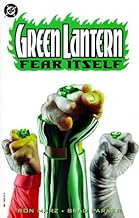 Written by Brad Marz. Drawn by Brad Parker.
Painted colours: The Hories. Letters: Chris Eliopoulos.
Rating: * * 1/2 (out of 5)
Number of readings: 1
Reviewed posted: June 2024
This was also reprinted as DC Comics Presents 100 Page Spectacular: Green Lantern: Fear Itself in 2011
Fear Itself is an original graphic novel that exploits the multi-generational nature of DC's fictional universe, by telling a tale that spans decades and involves three different Green Lanterns confronting the same menace -- as well as, in supporting parts, three iterations of the JSA/JLA.
It begins during WW II when an ill-conceived plot by some Nazi spies unleashes a kind of Lovecraftian-seeming monster, which must be confronted by Alan Scott, the Golden Age Green Lantern, as well as the Justice Society of America. The catch is the creature has the ability to strike at people psychologically, making them confront their inner fears. Then we jump ahead to Hal Jordan, the Silver Age Green Lantern, and the Silver Age Justice League of America (or rather DC's post-Crisis version of them) facing a recurrence of the same menace. And then finally the then-current Green Lantern, Kyle Rayner, and the modern Justice League.
On one hand its a fun indulgence, a single story involving three Green Lanterns in separate Acts of the story, with supporting turns for the other heroes, and given a prestigious painted art presentation that lends the thing a certain grandeur. The combo of pencil artist Brad Parker and painter The Hories can be a bit uneven in spots, but at its best does genuinely evoke a bit of Alex Ross -- the guy who arguably made painted comics a "thing"; especially with the use of sunlight on the figures. Admittedly, other times the figures are a bit stiff, the art not as detailed or realistic as Ross. Still, it's mostly appealling and effective.
The downside is, well, it's pretty bare bones for a 76 page epic graphic novel. It's fun to look in on the different eras of GLs and the concurrent teams they belonged to. But in terms of plot/character stuff it's fairly simple. Each section just involves the same creature arising, GL and friends racing to fight it, GL being zapped psychologically -- and mostly shrugging off the fear effect with little real effort. And that's it. Until Kyle figures out something his predecessors missed. And of course there are little bits meant to resonate with hard core fans -- Hal's greatest fear is revealed to be seeing Coast City destroyed, and fans at the time knew that Hal would later go crazy after witnessing Coast City get destroyed! Not exactly subtle or nuanced, eh?
The result is not without its fun appeal (particularly seeing the Golden Age JSA given the fully painted treatment!), especially if you can get it cheap (such as the later comic book reprint version). But it's another epic graphic novel that, honestly, feels like it could've been told almost as well in a single issue of a regular comic-sized comic.
Green Lantern: Ganthet's Tale 1992 (SC GN) 62 pgs.
 Written and illustrated by John Byrne (from a story by Larry Niven).
Colours: Matt Webb. Letters: John Byrne. Editor: Denny O'Neil.
Rating: * * (out of 5)
Number of readings: 1
Reviewed: Feb. 2015
Well...that was odd.
Sorry, but that was kind of my reaction reading Ganthet's Tale. It's a Green Lantern one shot/graphic novel with the story credited to Larry Niven, a popular science fiction writer and novelist with no particular association with comics, and written and illustrated by John Byrne, a veritable giant of the biz but with no particular association with Green Lantern of which I'm aware (though I'm sure he's written and/or drawn for the character before, if only guest starring with Superman or something).
It's kind of hard to summarize even as conversely, it's actually quite a thin plot. But that's because it draws upon pre-established Green Lantern lore. Namely that millennia ago, a rogue Oan -- Krona -- sought to discover the origins of the universe, despite such a quest being taboo. In so doing he unleashed evil for the first time upon the universe, which then led the other Oans to become the Guardians of the Universe, feeling responsible for his primal crime.
So the plot here has Green (Hal Jordan) Lantern approached by one of the Guardians of the Universe who identifies himself as Ganthet, who wishes Hal's help -- first to locate an off-shoot of the Guardian's own race who migrated to earth millennia ago and were the inspiration for, um, well, leprechauns. Then, after recruiting a single one of these off-shoots (though Ganthet was hoping to acquire more) the three of them head off into space to stop another rogue Guardian from repeating Krona's experiment -- along the way, Ganthet also reveals that the traditional story about Krona (and how he glimpsed a mysterious cosmic hand that created the universe) wasn't entirely true.
The plot itself draws heavily upon established Green Lantern mythos, implying this wasn't simply a generic story Niven tossed off that could've applied to any character (unless Byrne and the DC editors were involved in shaping it to that mythos -- perhaps Niven's "plot" was simply the "sci-fi" stuff involving entropy and looping the end and the beginning of the universe). Yet it doesn't gel with GL lore in other ways (such as a character claiming the GL Corps has members on every inhabited planet in the universe, when their designated space sectors usually encompass many inhabited worlds).
Though some of that may just relate to the whole pre-Crisis/post-Crisis quagmire DC created when it tried to reboot its universe in the mid-1980s, where comics were constantly re-telling (and re-inventing) established backstories. For instance, Ganthet claims the story of the primal hand was actually a cover for a greater secret the Guardians had been protecting relating to their true origins. Except nothing about their true origin seemed a surprise to me, as I thought it was long established -- at least in pre-Crisis lore. It's a bit like doing a Superman story where the surprise revelation is that Krypton exploded! It also just doesn't make a lot of sense, or at least it seems implausible (though I'm trying to be vague to avoid spoiling anything) -- since it requires that people throughout the universe just assumed the Guardians were as old as creation.
But even besides that, the story, as I say, just seems odd -- which is really just my polite way of saying it wasn't very good, but it wasn't very good in an odd way. Starting with the whole leprechaun thing! Or maybe starting with why Ganthet is even seeking out this off-shoot of his people at this particular time. Or why he seems to then invite them to become members of the GL Corp -- but if that's all he was doing, recruiting GL's, why did they have to be fellow Oans? Or, like -- how would the story be much different if they had dropped that aspect entirely?
Or how about: why is Ganthet the only one looking into this matter of the rogue Oan? Why does he not explain what's going on right away, and why doesn't GL seem more curious?
Frankly, you almost wonder if Niven didn't so much turn in a story as he handed in some random ideas and left it to Byrne to stitch them together.
There's a certain glib light-heartedness to the story, the characters themselves acting rather blasé, which means there's little dramatic oomph to things -- even when we get toward the climax and the fate of the universe is at stake.
Since the story is called "Ganthet's Tale" you can suspect two things: a guy named Ganthet is going to be pretty paramount and he's going to do a lot of talking. Both of which prove quite true, and not necessarily to good effect. While Hal has next to no personality. As mentioned, I'm not sure Byrne had written much for the character before. The result is Hal seems more like a plot device than a person. And not even an especially relevant plot device.
Byrne's art is certainly solid enough. Better, in fact than some of his latter day work, though the inking is rather thin, not really adding much shape or contour to the figures or atmosphere to the environment. I think he was trying for a sketchier, feather-ier line work at that time, in the style of Joe Kubert or Gil Kane, without quite pulling it off with the same aplomb.
This is one of the few stand alone Hal/GL graphic novel/specials and, sadly, it's underwhelming.
Green Lantern: Legacy - The Last Will and Testament of Hal Jordan 2002 (HC & SC GN) 106 pgs.
 Written by Joe Kelly. Pencils by Brent Anderson. Inks by Bill Sienkiewicz.
Colours: Ro & Bleyaert. Letter: Sean M. Konot.
Rating: * * 1/2 (out of 5)
Number of readings:
Review posted: Mar. 2016
The first thing to mention about Legacy: The Last Will and Testament of Hal Jordan is that it's not actually about Hal Jordan, exactly. Rather the central protagonist is Tom Kalamaku, Hal's long time friend and confidant. Continuity-wise it also takes place in that era after Hal had gone crazy and tuned into a mass murderer, sort of redeemed himself by saving the solar system, and was the "new" Spectre -- all of which might make it seem a bit weird and abstract for modern readers since these days Hal is back being Green Lantern, most of that continuity swept aside (and, indeed, DC has probably re-booted its universe a couple of times as well).
And such continuity issues are kind of important when dealing with "graphic novels" meant to stay in print for years -- because I'm not sure how much relevance, or resonance, it will have for modern readers.
So the premise is that Tom Kalamaku has sunk into alcoholic despair, not simply over the death of Hal -- but more importantly over Hal's betrayal of his principals. Tom, after all, not just Hal's friend -- but his number one fan, to boot. Then a mysterious lawyer shows up with a child that is, apparently, Hal's hitherto unknown son -- Hal's posthumous request being that Tom looks after him. As the child is also in possession of a power ring, this makes matters doubly complex -- triply so when a mysterious energy being keeps showing up trying to kill them. So Tom and the boy, Marty, head off, trying to find answers, having encounters with the JLA and the last remnants of the Green Lantern Corps (bereft of their rings, they're more just a bitter social club). Along the way there are flashbacks to Hal in action (just so we can still feel Green Lantern is involved) while Tom grapples with his feeling of bitterness and despair.
I tend to feel there can be a problem with comics that get too pretentious. Don't get me wrong: I'm the first to say I like super hero comics that have gravitas and grapple with moral and even political issues. What I mean is, there's a problem when the need to seem profound swamps too many other considerations. Legacy is over a hundred pages long, yet can feel more indulgent than illuminating.
It's not really clear how literally we are meant to take the story -- given no one really asks who this boy is or where he came from or who his mother is. The story even acknowledges this by having Tom briefly remark that there was something odd about the lawyer just showing up. But it's a story where the themes and symbolism is clearly meant to take precedence over the literal plot. Maybe that works for you -- maybe it doesn't. I'm reminded of some other extra-long graphic novels like Batman: Fortunate Son, Batman: Absolution, and Wonder Woman: The Hiketha to name just a few in which, likewise, the nuts and bolts of the plotting and "believable" characterization seemed to be sacrificed for the "important" themes and messages -- to varying degrees of effectiveness.
It can also feel a bit repetitive given the length. Tom has been the "sinking into alcohol and self-pity" route before (notably a run of stories in the early 1980s) so it's not necessarily out-of-character. But as the primary arc for this hundred page saga it can out stay its welcome -- not unlike a self-pitying drunk who just grumbles and grouches endlessly. Although I do believe writer Joe Kelly was genuinely interested in writing about Tom, as a character -- perhaps even seeing him as a bit of a surrogate (Tom a Green Lantern "fan" struggling to come to terms with Hal's betrayal of that legacy).
As I mentioned earlier, the whole continuity thing is an issue. For one thing, there seem a lot of comics which seem mired in trying to explain, rationalize, or dig for deep meaning in what were really just a bunch of ad hoc plot ideas and marketing gimmicks. This can result in "serious" stories that one suspects even a lot of the writers don't really feel in their hearts. I mean, the whole idea of Hal going bad and killing off the rest of the Corps was, itself, just an editorially encouraged sales-boosting gimmick (coming around the time of Batman: Knightfall and The Death of Superman). Unfortunately it then puts later writers like Kelly in the awkward position of trying to milk meaningful, philosophically relevant stories out of it and justify it in terms of the character's pre-established personality (when it doesn't necessarily gel with his personality!) and endlessly trying to explain how Hal was a true hero, ultimately, despite lapses into mass murder.
Now maybe that's just my hang up -- but as I suggest, the plot can seem a bit secondary to the themes of Tom's self-pity and coming to terms with the ambiguity of Hal's legacy, even as I don't really think those are strong enough ideas to sustain 100 pages.
As well, for a modern reader a lot of this story might seem untethered from anything relevant to the characters they know, so much narrative water having passed under the bridge, and with the flashbacks to Hal in action as GL minor little vignettes that don't really tell stories. Yet I don't think Kelly has shaped it sufficiently into its own story so that you can come to it fresh, with little knowledge or interest in the era in which it was set. (Indeed, even I'm not sure why Hal seems to appear both as the Spectre and as Parallax seeming concurrently).
The art by Brent Anderson (inked by Bill Sienkiewicz) is certainly decent enough and has an added resonance as Anderson (and Sienkiewicz as well, in his early days) echo a bit of the style of Neal Adams who was a signature Green Lantern artist in the early 1970s. I'm a little mixed on Anderson, I'll admit, liking his stuff a lot in some ways, in others finding it not quite as strong or compelling as, say, Adams at his best. Sometimes the faces and figures are brilliantly realized -- and sometimes a bit rough and hasty looking. Still -- the visuals belong in the plus column.
But as I say: read some years after it was first published, this more feels like a quaint product of its time. Yet it feels too overblown and lengthy for either a story about a supporting character getting back on his feet, or as a rumination on the legacy of a disgraced hero. Themes like that should be undercurrents in an epic, 100-page plot -- not the plot itself.
Green Lantern: No Fear (2006) 160 pgs.
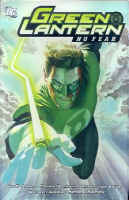
Written by Geoff Johns. Pencils by Carlos Pacheco, Ethan Von Sciver, Simone Bianchi. Inks by Jesus Mernio, Prentis Rollins.
Colours: Moose Baumann. Letters: Rob Leigh. Editor: Peter Tomasi.
Reprinting: Green Lantern (2005 series) #1-6, plus Green Lantern Secret Files #?
Rating: * * 1/2 (out of 5)
Number of readings: 2
This collects the first six issues -- along with Green Lantern Secret Files -- of the new Green Lantern series, featuring the newly ressurected, rehabilitated, and reinstated, Hal Jordan.
Hal was the alter ego of the character from the 1950s through to the early 1990s (save a period or two where he was replaced by John Stewart). Since Green Lantern wears a ring that gives him tremendous powers, it had been easy enough to shift who wears the ring. In the early 1990s, when DC was keen for "shocking" sales-boostin' gimmick stories, Hal went bad and eventually was killed, being replaced by Kyle Rayner. And though that character did well enough for a while, fandom has a long memory, and old time fans never quite gave up on seeing Hal brought back.
And he was, in the mini-series Green Lantern: Rebirth (which I below), which not only brought Hal back to life but also absolved him of most of the culpability for the things he did while bad (he wasn't himself).
The funny thing is, I gotta admit I'm a bit of a Hal Jordan fan. I never thought of myself as such, but when I look back through my comic collection, I realize I've amassed a fair number of GL comics -- from various Hal eras -- and many stand as some of my favourite runs of comics.
Though I like Hal, I had decidedly mixed feelings about Geoff Johns' Green Lantern: Rebirth, which attempted to reboot Hal for the modern generation. But once all that was over and done with, and Johns could now just focus on a monthly comic, things start out more sure footed. The initial three issue story arc concentrates on Hal trying to re-establish his civilian life in the newly reconstructed Coast City -- although "civilian" life is an odd description for it, as Hal decides to join the US airforce. While all this is going on, and Johns is introducing a new cast of supporting characters, a mysterious, homicidal android starts slaughtering its way across the countryside, heading towards Coast City faster n' you can say "hmmm, I wonder if this has any connection to Green Lantern's old foes, the android Manhunters?"
I had some qualms with the level of the violence in the story, as the android blows up busloads of innocent bystanders, and incinerates people in fairly gory detail, but that was a minor part of the saga. The art by Carlos Pacheco is bright and open, yet dynamic, and tells the scenes with clarity. The story isn't, perhaps, especially complex, but it's paced out well, with a few twists and turns, and appropriate cliff hangers between acts. Above all, Johns keeps the focus on character.
Granted, he tends to rely on exposition in place of demonstration, and his fixation on Hal being a heroic "man without fear" to the exclusion of much else means this isn't, perhaps, as well rounded, and as adult, a take on the character as we've seen in the past. Johns seems to belong to the school of thought that thinks to give a hero doubts or insecurities somehow demeans him.
Johns plays around with themes of courage vs. cowardice. It's not hard to read into discussions about Coast City -- which had been obliterated by an alien invader and is now being rebuilt -- a metaphor for the post-9/11 world. But ironically, the central concept of Hal bravely wanting to resume his life in Coast City contrasted with his brother's fear of moving back to the city, could easily be flipped on its head. Hal's obsession with recreating his old life reflecting a man afraid of change.
Bottom line, though: I liked the opening three-parter. Unfortunately, as much as I liked it...I was unimpressed with the next three-part story.
Here Johns seems to be channeling a few X-Files episodes in a story involving alien experiments -- in fact, I'd swear I've seen the opening scene before! The story involves old foes Hector Hammond, the Shark, and Black Hand. Green Lantern: Rebirth artist Ethan Van Sciver returns, and his style, though detailed in its realism, I find cluttered and overly dark, so that it's hard to quite tell what's going on.
And Johns' brutal excesses just get unleashed full tilt. I read somewhere that Johns' ressurrection of Hal was meant to herald a return to Old School heroism...well, Old School was never like this as Johns and Sciver just wallow in violence. When the key "action" scenes in issue #4 seem to involve Hal getting into a pointless mud wrestling (!) contest with fellow Green Lantern Kilowog, or slugging guys trapped behind bars and beating the crap out of Hammond -- a quadriplegic -- you know Johns' notion of heroism and mine are lightyears apart. I've read a couple of GL vs. Hammond stories from many years ago...and in neither one did the writer feel it appropriate for GL to assault a man who, after all, can't fight back on a physical level.
And it just goes from there as the Shark munches his way through swimmers (and we're treated to bloody limbs and a severed eye ball!) and Black Hand announces Hal'll be his twenty-third kill that day. Johns seems to be a one trick pony when it comes to villains: make them nastier and more sadistic than they ever were before -- though having Hammond go all Hugo Strange (a Batman foe if you don't get the reference) and develop a fixation on Hal was a potentially interesting touch.
The pacing just seemed -- off. I found this story arc just kind of...bland. I didn't really find myself interested in where it was headed, nor why, as it just gets cluttered with fight scenes and arch foes (Johns just shoe horning in villains like they do in Hollywood super hero movies). I found it visually confusing, particularly in the final chapter drawn by Simone Bianchi who has a beautiful, semi-photorealist style...but a weaker eye for storytelling, as where characters were in relation to each other was often confusing.
Another problem is just the familiarity of it all. Although Johns revamps Hal's civilian life, he then proceeds to trot out all the old foes (even if he and Van Sciver have radically altered them in personality and look -- I mean, when did Hammond's head get as a big as a wardrobe?). Personally, I'd have preferred the opposite. Return the familiar cast of Tom Kalmaku (a sympathetic Inuit character in a medium not exactly brimming with Inuit protagonists), Carol Ferris, etc. (particularly as the notion of GL as a de facto agent of the airforce just seems repetative, as he's already an agent of the Guardians of the Universe) -- but with new stories and imaginative threats. For that matter, why bring back old foes...if you're going to so mess with them they aren't really the same characters?
As noted, Johns trucks out a lot of themes -- sometimes seeming to sacrifice the needs of the character and the scene for the sake of symbolism. Of course, the problem with wanting to be taken seriously in some regards, is it kind of opens you up to all sorts of scrutiny. There's also a sexist undercurrent -- the modern take on Hal is as a cocky womanizer who sees every woman as a potential conquest...and instead of an immature character flaw, this is apparently supposed to make him cool (and who says comics are no longer written by, and for, dateless nerds?) And a special focus has now been given to GL's relationship to his dead father, while his late mother is, if anything, portrayed as something that was keeping him from being himself. This is nothing new in many comics, of course -- Batman's motivation is that both his parents were murdered, yet particularly in recent years, his focus often seems to be on the death of his father, with his mother more an abstract side issue.
There's also a curious contradiction in that Johns wants Hal to be the stereotypical rebel, who doesn't respond well to authority...then has it be that he desperately wants to re-enter the military, a profession all about deference to authority! (Not to mention that sort of runs counter to previous takes on the character where, as an agent of the Guardians of the Universe, he was one of the few super heroes who wasn't a rebel/free agent). This military-centric focus is also a bit off-putting, such as a sequence where a navy man and his girlfriend are found mutilated by the Shark...and GL and his military contacts seem to regard the civilian's death as barely an afterthought compared to the sailor's death.
Anyway, those are just random thoughts that came to me. But the bottom line is: I
enjoyed the first three-part story...and pretty much didn't like the second three-parter. And as much as I kind of like the idea of seeing Hal Jordan back in action...Johns has left me somewhat on the fence and disinclined to follow the series -- at least while Johns is at the creative helm.
This is a review of the stories as they were first serialized in the monthly comic.
On to Green Lantern Reviews Page SIX
Back to Green Lantern Reviews Page FOUR
or
Back to 