 The
Masked Bookwyrm's Graphic Novel (& TPB) Reviews
The
Masked Bookwyrm's Graphic Novel (& TPB) Reviews
Green Arrow / Green Lantern ~ Page Two
for a complete alphabetical list of ALL reviews start hereA - B - C - D - E - F - G - H - I - J - K - L - M - N - O - P - Q - R - S - T - U - V - W - X - Y - Z
Green Arrow Reviews
For a complete list of all GN/TPB reviews, go HERE
Green Arrow Published by DC Comics
|
Writer: Mike W. Barr. Pencils: Trevor Von Eeden. Inks: Dick Giordano. Rating: * * * * 1/2 (out of 5)
This mini-series was the Emerald Archer's first self-titled comic...despite
having been around since the 1940s. He'd starred in back up features, and
shared co-starring credit with Green Lantern
for a while, but that was all. That probably made this the longest Green
Arrow epic -- at least until the late 1980s when Mike Grell overhauled
the character and he landed a second mini-series (The Longbow Hunters) as well as a monthly title.
But for the Bronze Age version of the character, this
mini-series was it.
The story has Oliver Queen, long since deprived of his former fortune,
being invited to the reading of the will of a wealthy widow he was once
close friends with but hasn't seen in a while...only to find that he's
her principal beneficiary, willed controlling stocks in her chemical company.
It doesn't sit well with her kin folk, and pretty soon people are trying
to kill him, leading him to suspect there's corruption within the company
tied to some sort of international conspiracy.
I could be accused of having knocked writer Mike Barr a time or two
before, but recently re-reading this story (I first read it years and years
ago) it's very good. Barr is often a guy who seems genuinely enthusiastic
about his projects (whether it be Batman,
Star
Trek, or Camelot 3000) generally,
but here, he really makes it work. He seems to have a genuine affinity
for Green Arrow, which allows him to infuse the scenes with asides and
character dialogue, that makes the moments live and breathe beyond
just progressing the plot. Sure, by this point GA had become a slightly
watered down version of his Bronze Aged self, lacking some of the political
fire that Denny O'Neil introduced into the character in the late 1960s/
early 1970s (modern writers have described him as a Communist, but I think
Anarchist is more accurate -- Anarchy in its true, political sense). But
there's still enough of the character's quirks -- hot tempered, chilly
eating, somewhat childish -- to make him an entertaining, dynamic figure.
The story is basically a mystery, although with lots of action and the
occasional super villain dropping by, as well as an obligatory appearance
by GA's lady love, The Black Canary (though her role is smaller than one
would expect). Barr has tried his hand at mysteries before, with mixed
results. But this works well. And it works precisely because Green Arrow
seems out of his depth employing deductive reasoning, trying to outwit
people who may be smarter than he is. The reader can identify with his
humanness, his missteps and goofs as he stumbles his way through, even
as it allows Barr to excuse the occasionally half-baked approach to the
case. There's also an appeal because it seems less like a super hero story,
than a story starring a super hero. The whole idea of the unexpected inheritance
and the subsequent mysterious goings on would've made a decent story even
if the hero didn't dress in tights and fire novelty arrows.
Perhaps being teamed with the dynamic Trevor von Eeden inspired Barr.
Von Eeden isn't afraid to cram as many panels as a scene needs into a page
(I counted 18 panels on one page!) allowing a scene to be broken down into
as many moments as needed, allowing Barr to indulge in richer exchanges
and more textured dialogue. Of course, Von Eeden is also there for big panels,
splash pages and the action...just so you don't get impression of an entire
series comprised of tiny panels. Von Eeden's eclectic panel arrangement
can, at times, get confusing, or bizarre, but at other times it works exceptionally
well. At a time when Howard Chaykin (in American
Flagg) and even Frank Miller were experimenting with ways to tell a
story in comics, Von Eeden was perhaps an unsung part of that movement.
Some scenes are confusing, but others achieve a complexity that is quite
impressive. Aren't sure which panel goes before which? That's 'cause Von
Eeden (and Barr) are trying to portray the idea of simultaneous actions.
While other scenes just benefit from Von Eeden's nice eye for telling a
scene (like a sequence of GA ransacking a coroner's files). And, of course,
he knows how to draw, to boot.
Admittedly, the mystery can be a bit unevenly
developed. One moment the widow's death is treated as natural, the next,
everyone's talking as if it's assumed she was murdered. And though you
have a pretty good idea by the end of what was going on, who exactly did
what is a little harder to pin down. And having iconoclastic GA team up,
however reluctantly, with a CIA agent would seem to be against the character's
nature, as is the casual way GA accepts the CIA agent's use of lethal force
(though that may reflect the editorial attitudes that had already muted
the character and would eventually lead to Mike Grell's refashioning the
character as a more violent figure -- replacing trick arrows with pointy
ones). And technically, I think the CIA guy is out of his jurisdiction
anyway.
Of course, I often find myself at odds with some of Barr's ethics in
his stories, particularly pertaining to violence.
Those moral qualms aside, this is funny, occasionally smart, well scripted,
fast-paced, a little off-beat, dynamically illustrated and generally pretty
darn entertaining. A somewhat ignored effort, Barr and Von Eeden have a
right to be proud of it.
|
 (1983, four issues, DC Comics)
Green Arrow / Black Canary: For Better or for Worse 2007 (SC TPB) 200 pages
Written by Denny O'Neil, Elliott S! Maggin, Alan Moore, Mike Grell, Kevin Smith, Chuck Dixon, Brad Meltzer. Illustrated by Dick Dillin, Mike Grell, Phil Hester, Dick Giordano, Jose Luis Garcia-Lopez, Klaus Janson, Rick Hoberg, Rodolfo Damaggio. Inks by various.
Colours/letters: various.
Rating: * * 1/2 (out of 5)
Number of readings: 1
Additional notes: intro by Dennis O'Neil.
Green Arrow and Black Canary began as unconnected, second string characters who were eventually made members of the Justice League of America in the 1960s. From there, the idea of romantically pairing them arose: it proved a long, volatile relationship (comics writer Mike Barr once remarked in an editorial they were the only comic book characters of their day he believed had a sex life!) The two appearing together in various Green Arrow titled back up stories, though sometimes it was the Canary who had a series. But as DC's fictional universe became increasingly continuity heavy, they broke up, Green Arrow got killed off, then came back to life and, eventually, the two became a couple again. (And, of course, DC's entire universe was reinvented a time or two, so that, in essence, the characters in the early stories reprinted here aren't really the same as in the later stories!)
So should a Green Arrow/Black Canary collection be a grab bag of tales? Or a primer on their convoluted history?
This TPB can be broken into two distinct sections. The first section presents a smattering of their Silver Age/Bronze Age appearances:
The collection begins with their first major pairing from Justice League of America #75 (1969) -- a story which seemed to mark the transition of Green Arrow from playboy to pauper, and has the League battling evil dopplegangers of themselves. It's enjoyable enough for its era. This is followed by a couple of short tales, "The Plot to Kill Black Canary" and "Zatanna's Double Identity" -- the former nothing special (despite having been included in a Green Arrow "best of" digest decades earlier), while the latter is enjoyable with enough of a puzzle to sustain its 7 pages.
Batman's arch foe, The Joker, had his own short-lived comic in the 1970s (though still a homicidal villain, he wasn't quite as brutally violent as writers today like to write), where the "guest star" super heroes were the de facto stars of the various issues (one wonders if the series was intended as a kind of try out for heroes without their own monthly comic). The fourth issue has the Joker going up against Green Arrow after the villain becomes infatuated with Dinah Lance (the Canary). Beautifully drawn by Jose Luis Garcia-Lopez, it's an enjoyable, breezy romp and is one of the very few feature-length (18 pages) solo Green Arrow comics until the early 1980s!
There's a two-parter from the pages of Green Lantern (when Green Arrow shared co-starring credit), an entertaining tale of GA being roped into an assassination plot while Hal (Green Lantern) Jordan (and secondary GL, John Stewart) faces a separate ordeal in space. Though once again, the Canary is just there to be rescued. It's drawn by Mike Grell who would later write GA's 1980s comic.
The final selection from this part of the collection is a two-part back up story that one assumes was included because it was written by soon-to-be comics legend Alan Moore (and drawn by Klaus Janson). I had earlier read it in Across the Universe and though I enjoyed it more this time, it remains a slight, insignificant tale.
There were better, more character significant tales that could've been included. And they could've shown some balance by presenting a tale where Black Canary takes the lead.
And though the inclusion of works by seminal forces on GA like O'Neil, Maggin, and Grell are valid, an artist like Trevor von Eeden and, to a lesser extent, writer Mike Barr were also major influences on the characters and their work might've warranted representation. (Neal Adams' classic GL/GA run was probably left out because those issues have been reprinted so often over the years)
The second half of this collection shifts to being the "primer" idea to which I alluded. Starting from the late 1980s (DC's re-booted reality) the intent here is to chronicle the changes in the characters and their relationships, so instead of getting full issues, there are excerpts from longer adventures -- scenes heavy on character and continuity development. So we get a few pages from Green Arrow: The Longbow Hunters showing the couple moving in together, and a few pages from Green Arrow #75, showing how a brief temptation toward infidelity on GA's part led to them breaking up. We get GA's death, and others' reaction to the news, likewise his return and reuniting with the Canary. etc.
As comics become increasingly tangled up in continuity, the idea of a collection which basically provides a reader's digest version of the highlights isn't such a bad idea. On the other hand, as a collection picked up merely for some stories to read, you aren't really getting that. Sure, there's some decent character stuff, some cute quips (or, alternately, sober scenes), and some excerpts are reasonably lengthy...but it's still a bit unsatisfying
And for all the "dramatic" changes, their romantic status quo is re-established by the end. In other words, it's not like you really need to read these scenes to understand the characters' later adventures.
So although I didn't dislike reading those excerpts, for all their pretensions to greater sophistication over the 1970s tales...if I were re-reading this collection, it'd be the 1970s reprints I'd be more likely to re-visit.
So if you're an obsessive fan, desperate to read pivotal scenes that might be missing from your collection, this can provide some of that. But if you're just a casual reader looking for a nice collection of Green Arrow and Black Canary adventures, a lot of the collection will seem kind of frustrating -- like watching one of those budget-saving episodes of a TV series comprised of flashbacks to earlier episodes.
DC might've been better to release two TPBs. One, just a "Best of..." collection of self-contained stories (maybe with a few giving the Canary equal time), and a second comprised of more extensive excerpts that could be fashioned into a kind of graphic novel.
Green Arrow, vol. 1: Hunter's Moon
(2013) 156 pgs.
Reprinting: Green Arrow (1988) #1-6 - plus covers
Rating: * * 1/2 (out of 5)
Number of readings: 1
Review posted: June 2024
Suggested for Mature Readers
Hunter's Moon is the first in a series of volumes collecting the well-regarded Mike Grell-written Green Arrow series from the 1980s-1990s; a series which itself was both the first time Green Arrow had starred in an on-going monthly comic (despite having been created in the 1940s, and having had a mini-series in 1983) as well as an overhaul of the character (initiated in The Longbow Hunters -- also reviewed on this page). Grell's idea was to make the stories grittier, edgier. Gone are GA's non-lethal gimmick arrows. The character's more sombre, less the impulsive, chilly-eating, jazz lover. And the stories are meant to be more "realistic" -- at least in that supervillains and their like are mostly absent. Oh, and it was published as a "mature readers" series, with (some) profanity and adult themes.
The fact that this follows on the heels of The Longbow Hunters is worth mentioning. Despite this being volume 1, there are occasional references and appearances harkening back to previous events (such as GA encountering a mercenary he first met in The Longbow Hunters, or the last couple of panels of this collection in which we cryptically cutaway to a character you would only recognize from The Longbow Hunters).
And to be up-front: I wasn't that keen on the series or what Grell was doing with it. I read a few issues here or there over the years, and have sat down to read (and in some cases re-read) these issues now, some 30 years or so after they were published.
This six issue collection is comprised of three, two-part stories.
On the plus side is some decent art by Ed Hannigan. Grell was known as an artist-turned-writer, and had drawn the Longbow Hunters, but settles back to just scripting here. Grell's style is uneven, even kind of dodgy at times -- but has a weird appeal, even recognizing its flaws. So when he hands over the art chores to others, it can be a let-down. But Hannigan brings a particularly realist style to the stories that suits Grell's realist conceit, sometimes faces and poses even looking photo-referenced. The downside is sometimes the visuals can look a bit stiff, the figures ungainly. But it mostly works well -- at least for the flavour being attempted.
While Grell clearly wants his stories to seem serious and thoughtful. But whether they fully succeed is another matter. The dialogue can veer between some clever exchanges, some interesting moments -- to kind of clunky and heavy-handed. I go on (at some length) in my The Longbow Hunters review about the political/moral underpinnings of Grell's writing -- mainly because it's Grell (and the creative team on the series) who seem to want us to believe this is serious, meaningful stuff, beyond just gee whiz comic book adventures. Grell's philosophy has a kind of macho Libertarian streak, even as in other ways he adopts more socially liberal attitudes; but a recurring thread in the stories is the streets are a jungle and only real men who don't play by rules -- and who aren't afraid to be brutal -- can save us (this is emphasized, not just by GA's abrupt decision to drop the gimmick arrows for pointy, steel tips, but recurring scenes of villains whining that they have rights, and that GA can't do anything to them -- even as he proves they don't and he can).
The first story essentially both establishes the grittier themes idea, and the tougher GA idea. A serial child killer has won a motion for a re-trial, and while he is released back onto the streets (albeit confined to his house), the only survivor and eye witness, now an adult, is being targeted. GA (and the police) suspect the serial killer is behind the attacks -- but are having trouble proving it. After all, his alibi is that the police themselves are watching his house. In that sense, the story is partly a mystery -- whether the serial killer is responsible and, if so, how is he getting past the police surveillance?
The second story plays around with cold war ambiguity. GA gets caught up in a race by two superpowers for a potentially deadly pathogen that is wanted by the Chinese and the Russians -- the US government not yet even aware of it! Leading to GA and another mercenary on an island off the coast of Seattle playing cat and mouse as they each try to recover the canister.
The third story tries to ladle in a bunch of themes -- gay bashing, juvenile crime, street gangs. All to somewhat mixed effect. This story in particular smacks of Grell's mix of earnestness and hubris, like he's trying to write a gritty story about themes and ideas he picked up by half-listening to an NPR broadcast while washing dishes. But that shades a number of the stories.
It perhaps also reflects a problem with Grell's earnest "issues"-focused approach that characters are often treated as abstracts, there to serve as mouthpieces for Grell's point, or to move the plot along. In the third story about street gangs, GA is drawn into it because of a teen who works for his girlfriend, Dinah (a.k.a. The Black Canary) -- but that teen never becomes a characters whose emotions and fate are given much attention. While in the second story GA hooks up with an Indigenous girl/archaelogist, but she never becomes anything more than someone to give GA someone to talk to, and to rescue.
I guess my point is: does it undercut stories of social relevance when the human factor seems so secondary?
Anyway, I finish this collection with pretty much the same ambivalence I went into it with. A mix of decent dialogue with clunky, heavy handed dialogue, a leisure-pace that can be sort of effective (instead of just careening from splash page to splash page) but can mean the various two-issue tales often feel a bit slow-moving, without enough plot/character stuff, or intriguing/surprising twists/turns, to fully justify the 40+ page tellings.
Not terrible. Just not great, either.
Green
Arrow: The Longbow Hunters (1988) 150 pages
Reprinting: Green Arrow: The Longbow Hunters #1-3 (1987)
Suggested for mature readers
Rating: * * * (out of 5)
Number of readings: 2
I've added a post-script at the end of some thoughts after rereading it a few years later -- and I've boosted the rating a bit.
Green Arrow had been around for decades, but other than sharing co-billing for a run of Green Lantern (collections reviewed further along), and starring in an entertaining 1983 mini-series (reviewed above), he had never had his own comic until the late 1980s. Originally published as a prestige format mini-series, The Longbow Hunters was intended to serve multiple purposes: kick start a Green Arrow monthly series, re-invent the character as part of DC's "post-Crisis" reality when it was overhauling many of its characters, and to present a "dark n' gritty, mature readers" take on the character in the vein of Frank Miller's Batman: The Dark Knight Returns.
Though I say "re-invent", this wasn't a complete re-imagining of the character, but follows from the character's established adventures. Approaching middle age, Green Arrow relocates to Seattle with girlfriend, fellow crime fighter Black Canary, and becomes involved in a search for two (yes, two!) separate serial killers, which leads to connections to organized crime and government skulduggery.
I knew this was supposed to transform the swaggering, hot headed, gimmick arrow firing GA into a more sombre, more vicious, pointy arrow firing character. And I assumed the story would show the transformation. Instead, writer-artist Mike Grell basically just jettisons the old for the new right off the bat, as Green Arrow gives some muddled rationale for how he has to take things more seriously, and dumps his old costume and non-lethal weapons without so much as a by-your-leave.
I'll admit, I kind of avoided this series for a long while, because I didn't really like what Grell did to Green Arrow, nor do I necessarily agree with the "vicious is better" school of super heroes. But time passes, I mellow, and have watched so many characters get so messed with over the years, that I can no longer take it that personally. But even with that laissez-faire attitude on my part, The Longbow Hunters is a fairly pedestrian effort.
Though Grell did an entertaining job as writer on his Warlord series -- slight, breezy plots but with a particularly well realized protagonist -- I've often had mixed feelings toward some of his other writings. In transforming GA as a personality, he basically robs the character of who he was, without really substituting anything in its stead. The result is a kind of blandly defined, generic hero -- and one that doesn't really bear much resemblance to the then-established personality (reading his dialogue, does this really "sound" like the guy who'd been popping up in comics for the previous twenty years?). And where Grell would kind of write long talky scenes...that isn't really that interesting talk. In one five page scene where GA talks with a cop, there are no less than three times the cop tells GA he doesn't like super heroes and GA better watch his step. Three times in one conversation! There's another scene where the villains have almost the exact same conversation they had earlier (to be fair, serialized over three issues, such repetition might be justified to recap info for the reader)
And the problem with the whole "dark n' gritty" movement is that it often seemed to be selling itself as more "realistic"...when there's very little that's realistic in a series like this. It's still full of unrealistic events (a serial killer who lives, not in suburbia, but the sewers), a simplistic -- even simple-minded -- plot, and a 150 page saga in which most of the characters are barely defined beyond the needs of the scene. It's drenched in the kind of macho, "real men don't play by rules" mindset, where GA breaks guys fingers and, as mentioned, starts brandishing pointy arrows, assuring us that only guys who don't play by gentlemen's rules can get anything done -- a kind of odd thesis when part of the villainy involves self-justifying rogue operatives who don't play by the rules. In other words, the very philosophy Green Arrow (and Grell) seem to endorse, is the very philosophy the villains embrace!
In the story, Grell has GA dismiss his trick arrows as a crutch, implying the better bowman uses real arrows -- but the point of the trick arrows was 'cause GA wasn't trying to hurt anyone (much). It doesn't require being a "damn good" bowman if you don't care if you cripple or even kill your opponent.
And, as mentioned, the story is pretty thin, and only barely holds together logic-wise. Ironically, in the 1983 mini-series, there was an interesting playing-against-type idea of having GA try to unravel a mystery...and there was some interesting plotting (and humour) from having the non-detective GA try to puzzle a mystery. Here, again GA is faced with a mystery which he seems wholly ill-equipped to deal with -- but, in this case, Grell doesn't seem to see the irony. So although we know there's a mystery, Green Arrow makes no attempt to actually investigate it, he only "solves" it because it's explained to him in the end.
As an artist, Grell has always been uneven, but is generally one I kind of like, and there's an appeal to his work here (particularly faces) -- Grell wrote, but didn't draw, the subsequent monthly series. Although he maybe experiments a bit with the panel arrangement a few times -- not altogether successfully, where I had to read over some pages a couple of times to figure out how it was meant to be read!
As mentioned, this was a "mature readers" comic, with some gritty violence, profanity, mature subject matter, and some (brief) nudity. Black Canary is particularly poorly treated in the series, ending up captured and tortured by some villains, in the story's perhaps most notorious sequence.
For fans of the subsequent series, this, of course, kick started it all, and introduced the recurring character of Shado. But for those unfamiliar with the 1990s series, the character has undergone one or two "revisions" over the years since then, so that I'm not sure this is especially relevant from a "continuity" point of view (which is why I went into it judging it more just from a story point of view).
All in all, I'll admit, I can't really say I liked The Longbow Hunters -- even ignoring any philosophical qualms, it's a kind of thinly plotted, not especially exciting effort. Yet, conversely, there's a certain breeziness to it, that means it trundles along and doesn't get too turgid or tedious.
POST-SCRIPT: Re-reading this a few years after I had last read it (and having given it next to no thought in the interim -- that's less meant as a dig, and more that I re-visit it with a bit of a fresh eye, not having remembered the plot or themes):
I don't have any big disagreements with my original review except I will maybe give the story a slight nod by repeating that it breezes along relatively well (which I acknowledge in my original review). It's a bit odd to say since one of my complaints is that scenes feel a bit stretched. But I just meant in a page-turning way, it's okay (probably helped by Grell's use of few panels per page).
But I am struck by the moral/ideological aspects. It's common for right wing/conservative people to decry left/liberal stories that are "politically correct" or "virtue signalling" or which "force" politics into the stories -- while ignoring when the politics are crammed in from the other side. But The Longbow Hunters is so clearly Grell trying to reshape the character to his ideological vision that it can feel self-conscious (regardless of whether or not you agree with Grell). There's more than one scene where GA brutalizes a thug or punk and the character whinges that GA can't do that, that he's one of the good guys -- even as GA does do that. Talk about an author inserting his politics/ideas into the story by literally spelling it out in the dialogue.
The curious thing is that Grell takes on the property after years of being associated with the character off and on. Yet proceeds to reinvent him as if he never really like the character as he was. I think Grell really was trying to make the character more personal to him (I believe Grell does sport a similar beard, and is an archer). And maybe that's something that I can appreciate: an author identifying with his character rather than treating it as a caricature with which he doesn't identify. But as I mention, he sands off too many of the quirky personality traits (which Grell perhaps saw as too cartoony and "childish": the hot temper, the swagger, the love of chili and jazz) but in favour of making him a rather bland, stodgy personality.
Not that I'm prepared to pigeonhole Grell's politics too specifically. I mean, he definitely plays into the real-men-don't-play-by-rules, and tougher, meaner heroes are cool, and the system is weak, and punks-are-coddled style of reactionarism -- at the same time (some of) the villains are rogue CIA operatives involved in an Iran-Contra style scheme (which was a Republican project). Although there is a streak of libertarian-conservatism that sees all government (Republican. Democrat, CIA, etc.) as corrupt (the fact that the CIA guy gives a speech about safeguarding democracy, and then another character responds that he "almost" sounds convincing -- could either be inferred as criticism of American-style global interventionism...or simply a criticism that those doing it aren't true believers). And Grell, I think, sees himself as socially liberal (the story touches on the internment of Japanese-Americans during WW II, and I think in later stories Grell has had gay characters). All of which is to say I don't want to simplistically label Grell's politics. But the obvious theme here is that Grell wants to make the stories more violent, and gritty, and rejects the "fun" adventuring of early incarnations of the character. (Which is funny as previous GA stories often had their own explicit social-political streak).
It's not like Grell came up with a great plot that justified the prestige formal presentation (and almost 150 pages) and subtly worked in his ideas as he went. (Grell himself even has a scene where Green Arrow threatens a villain with exposure and the villain implies no one will believe GA's accusations because the plot he'd expose is unbelieveable, "lacks imagination," and is basically a cliched TV plot!)
As I mention in my initial review, one could imagine the story as a character arc, transforming the swaggering, hot headed, swashbuckling GA into a darker, grimmer figure -- investigating both a serial killer, and then Black Canary being tortured and brutalized. Except that's not really how it's structured. It pretty much begins with GA discarding his trick arrows for pointy ones and insisting he needs to take things more seriously in the first few scenes. While the brutalizing of the Canary, weirdly enough, doesn't actually have a lot of impact upon his actions in the climax. Making it all the more problematic -- even misogynist. Or at least luridly exploitive.
Why when given an opportunity to do a "mature readers" Green Arrow story did Grell and/or his editor immediately gravitate to "let's assault the female lead!"? But maybe it made more sense in an earlier draft of the plot.
The reason I focus on this is twofold. I've had readers of my reviews complain when I get political, but my point is it's Grell who is clearly using the work to say something -- I'm just trying to interrogate what. But also the whole point of these gritty makeovers is usually that the creators (and their fans) insist it's more realistic than the usual comic book-y shenanigans, more adult. But what's realistic about a middle-aged guy with a bow successfully taking on guys with machine guns? What's realistic about shooting an arrow through someone's hand and pretending that wouldn't cripple them? Or showing him shoot an arrow through someone's ear lobe? Or a panel where someone is skewered by a ricocheting arrow? I mean, I'm no expert on aerodynamics, but can arrows ricochet?
None of this is wrong in the context of telling a fun, swashbuckling adventure. It's just troubling when it's presented as more serious and realistic than, you know, boxing glove arrows! Because then it feels like the objection wasn't to the ludicrous implausibility of the old GA stories -- but simply to the fact that they weren't more violent.
Green
Arrow: Quiver (2002) 232 pages
Reprinting: Green Arrow (2001 series) #1-10
Additional notes: intro by Kevin Smith; cover gallery (squeezed into
three pages!); creator bios.
Mild mature readers caution
Rating: * * * 1/2 (out of 5)
Number of readings: 1
This chronicled the return of Oliver Queen a.k.a. Green
Arrow. It was a kind of unexpected comeback in that after having been around
since the 1940s, and undergoing various changes in costume, temperament,
and even armament, the character was killed off in the 1990s...paving the
way for his son to assume the mantle. One assumes junior proved less than
successful, because now Ollie's back. And the man behind the return is
filmmaker -- and long time comics fan -- Kevin Smith (who had previously
reaped accolades for a brief stint on Marvel's Daredevil).
Quiver was a critical and commercial success -- not too
shabby for a character generally regarded as a second stringer. But that
might have had as much to do with Smith's established fandom as it does
with the work itself.
This story has Oliver Queen mysteriously re-appearing
in his old stomping grounds of Star City -- not only unaware he's supposed
to be dead, but having forgotten the personal traumas he endured later
in life. In his mind, he's still the hot-headed, trick arrow firing, urban
revolutionary he used to be. He acquires a couple of new side-kicks --
an ageing millionaire and a teenage ex-prostitute -- and eventually hooks
up with some of his old super hero buddies, leading him to investigate
how and why he's back, taking him to heaven and battles with demons.
The story, as Smith proudly admits in his introduction,
is heavily mired in continuity -- not only referencing past GA stories,
but there are plenty of guest appearances -- including Hal Jordan a.k.a.
Green Lantern a.k.a. the modern Spectre (not yet Green Lantern again) -- and references, from a scene
where a character sees a white-skinned man trapped in a bottle (from Neil
Gaiman's The Sandman #1) to the obscure
DC Comics' property, Stanley and his Monster (confusing given that GA's
benefactor is also named Stanley). To Smith's credit, much of this is either
explained as you go or you don't really need to know it to understand what's
happening. Still, this isn't really meant to be a jumping on point for
those utterly unfamiliar with GA. Smith also brags about how he wanted
to write a 10 issue story that had 20 issues worth of dialogue. Fair enough,
and it isn't too wordy or bogged down in dialogue. But what he fails to
mention is that he may have 20 issues worth of dialogue...but what seems
more like five issues worth of plot. Early on we are introduced to two
main questions -- how did GA return from the dead, and who is the serial
killer of children that is plaguing Star City? But those remain the main
questions for the entire story! Worse, Smith throws in some red herrings
that turn out to be pretty blatantly that...and when we finally learn why
the villain was doing what he was doing (killing kids) it seems pretty
dodgy at best. Nor does Smith pad things out with episodic adventures --
GA hooks up with Aquaman to battle the Black Mantis (uh, when did he become
green???), but it's more just an extended fight scene, rather than a "story"
per se.
Yet, with all that being said, it remains a reasonably
enjoyable read -- I never found myself bored, or losing the impetus to
turn to the next chapter. It benefits from a sprightly tempo, the humour,
and its emphasis on familiar characters interacting.
But for all the metaphysical heaven and hell stuff, it
never quite makes the leap up to actually being profound or relevant. And
Smith's handling of characters is uneven. Being a writer best known for
comedies, he brings a light-heartedness to some of the proceedings, but
like a lot of modern comic writers, sometimes the characters are made to
do and say things for the sake of a joke, rather than because it's in character.
Admittedly, I'm speaking from the point of view of an older reader, with
his own notions of who these people are, and maybe I'm just out of step
with DC Comics' current visions of its heroes. But grim Aquaman goofing
off whilst introducing the revived GA to fellow Justice League members?
Wonder Woman -- the emissary of peace -- musing how she's tempted to cut
off his other hand for making her wait? There's a sense Smith is having
too much fun with these characters.
Other times, though, Smith does seem to have a sense for
what makes the characters tick. Although at one point Green Arrow suggests
he can't stand Batman, later, when the two hook up for a few issues, Smith
does a decent job portraying the uneasy but genuine camaraderie that used
to mark their team ups in The Brave & the Bold.
And, to be fair, the humour does sometimes work well --
out of character or not. Particularly the humour derived from GA's amnesia,
like seeing a cell phone and assuming it's a super-villain's hi-tech device,
or treating Wally (the Flash) West as though he's still a kid.
Curiously, Smith seems a bit unsure of Green Arrow himself
-- a character who, admittedly, has changed over the years. He wants to
cast him as the loud- mouthed Anarchist rebel of the early 1970s -- even
as he seems to dismiss GA's political harangues as just fodder for jokes.
Which might explain why there's a decided lack of a socio-political edge.
When Smith throws in the teenage prostitute, one at first thinks -- ah
hah! he's going to emulate earlier Green Arrow writers by exploring social
dilemmas. But then the girl simply becomes a perky, wisecracking sidekick.
Gosh, and here we all thought being molested as a kid, and turning tricks
on the street, would leave you emotionally scarred! Apparently not in Smith's
four-colour world. Smith's GA lacks the Jazz-loving, chilli-eating earthy
passion of his seventies incarnation, while lacking the sober maturity
that was -- I think -- the point of Mike Grell's late 1980s- 1990s version.
He seems an echo of earlier writers' visions.
At least, I think that was supposed to be Grell's
take on the character. The very few stories I read from Grell's dark n'
gritty, macho-fied tenure struck me as, frankly, dully plotted, top-heavy
with statistics, and with GA almost entirely sapped of personality!
Even the initial notion of returning GA to his pre-Grell
1970s persona turns out to be a non-starter. By the end of the saga he
seems to have returned to his more recent nature, including implying he's
going to once more dump his non-lethal arrows for the nastier pointed ones
Grell gave him.
The art by Phil Hester is of the modern, somewhat cartoony
school that often leaves me with mixed feelings. On one hand, it's energetic,
and tells the story with reasonable clarity, on the other hand...it is
kind of cartoony. Combined with Smith's script it can reduce the "human"
element even more to caricature, where the story seems just about comicbook
figures rather than real, flesh and blood people.
As a screenwriter, Smith has never met a four letter word
he couldn't work into a sentence...repeatedly. Working in mainstream comics,
he's kept on a tight leash, but there's still enough sexual innuendo and
even some grisly bits that might warrant a slight "mature readers" caution.
As well, the breaks between chapters aren't clearly marked -- but that's
nitpicking.
Ultimately, Quiver is an enjoyable, readable story --
particularly fun for comic fans because Smith, himself, is a fanboy and
doesn't mind who knows it. But as a saga exploring good and evil and the
human condition, as a 220 page epic of adventure and darying do, it doesn't
quite hit a bull's eye.
On to Green Lantern / Green Arrow Reviews Page
THREE
Back to Green Lantern Reviews Page
ONE
or

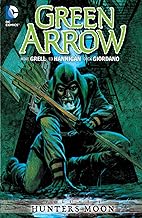 Written by Mike Grell. Pencils by Ed Hannigan. Inks by Dick Giordano & Frank McLaughlin.
Colours: Julia Lacquement. Letters: John Costanza. Editor: Mike Gold.
 Written and illustrated by Mike Grell (with assist from Lurene Haines).
Colours: Julia Lacqement. Letters: Ken Bruzenak. Editor: Mike Gold.
 Written
by Kevin Smith. Pencils by Phil Hester. Inks by Ande Parks.
Written
by Kevin Smith. Pencils by Phil Hester. Inks by Ande Parks.
Colours: Guy Major. Letters: Sean Konot. Editor: Bob Schreck.
Back to 